Privacy Policy
Table of contents
- Introduction and overview
- Application scope
- Legal bases
- Contact details of the person responsible
- Storage duration
- Rights according to the General Data Protection Regulation
- Data transfer to third countries
- Security of data processing
- Communication
- Order processing contract (AVV)
- Cookies
- Webhosting introduction
- Web Analytics Introduction
- Content Delivery Networks Introduction
- Cookie Consent Management Platform Introduction
- Security & Anti-Spam
- Web design introduction
- Online map services introduction
- Content search provider introduction
- Online booking systems introduction
- Explanation of terms used
- Conclusion
Introduction and overview
We have written this data protection declaration (version 05/29/2026-113219170) to provide you with the requirements of General Data Protection Regulation (EU) 2016/679 and applicable national laws to explain which personal data (data for short) we as the controller - and the processors commissioned by us (e.g. providers) - process, will process in the future and what legal options you have. The terms used are to be understood as gender-neutral.
In short: We will inform you comprehensively about the data we process about you.
Privacy policies usually sound very technical and use legal terms. This data protection declaration, however, is intended to describe the most important things to you as simply and transparently as possible. To the extent that it promotes transparency, technical terms are explained in a reader-friendly manner, links to further information are provided and graphics are used. We thereby inform you in clear and simple language that we only process personal data as part of our business activities if there is a corresponding legal basis. This is certainly not possible if you make as brief, unclear and legal-technical statements as possible, as are often standard on the Internet when it comes to data protection. I hope you find the following explanations interesting and informative and perhaps there is one or two pieces of information that you did not know before.
If you still have any questions, we would like to ask you to contact the responsible body named below or in the legal notice, follow the existing links and look at further information on third-party sites. You can of course also find our contact details in the legal notice.
scope
This data protection declaration applies to all personal data processed by us in the company and to all personal data that companies commissioned by us (contract processors) process. By personal data we mean information within the meaning of Article 4 No. 1 GDPR such as a person's name, email address and postal address. The processing of personal data ensures that we can offer and bill our services and products, whether online or offline. The scope of this data protection declaration includes:
- all online presences (websites, online shops) that we operate
- Social media appearances and email communication
- mobile apps for smartphones and other devices
In short: The data protection declaration applies to all areas in which personal data is processed in a structured manner within the company via the channels mentioned. If we enter into legal relationships with you outside of these channels, we will inform you separately if necessary.
Legal basis
In the following data protection declaration we provide you with transparent information on the legal principles and regulations, i.e. the legal bases of the General Data Protection Regulation, which enable us to process personal data. As far as EU law is concerned, we refer to REGULATION (EU) 2016/679 OF THE EUROPEAN PARLIAMENT AND OF THE COUNCIL of April 27, 2016. You can of course access this EU General Data Protection Regulation online EUR-Lex, access to EU law, can be found at https://eur-lex.europa.eu/legal-content/DE/ALL/?uri=celex%3A32016R0679.
We only process your data if at least one of the following conditions applies:
- Consent (Article 6 paragraph 1 lit. a GDPR): You have given us your consent to process data for a specific purpose. An example would be saving the data you entered on a contact form.
- Contract (Article 6 paragraph 1 lit. b GDPR): In order to fulfill a contract or pre-contractual obligations with you, we process your data. For example, if we conclude a purchase contract with you, we need personal information in advance.
- Legal obligation (Article 6 paragraph 1 lit. c GDPR): If we are subject to a legal obligation, we process your data. For example, we are legally obliged to keep invoices for accounting purposes. These usually contain personal data.
- Legitimate interests (Article 6 paragraph 1 lit. f GDPR): In the case of legitimate interests that do not restrict your fundamental rights, we reserve the right to process personal data. For example, we need to process certain data in order to operate our website securely and economically efficiently. This processing is therefore a legitimate interest.
Other conditions such as the perception of recordings in the public interest and the exercise of public authority as well as the protection of vital interests generally do not apply to us. If such a legal basis is relevant, it will be shown in the appropriate place.
In addition to the EU regulation, national laws also apply:
- In Austria this is the Federal Act for the Protection of Natural Persons with regard to the Processing of Personal Data (Data Protection Act), or DSG for short.
- In Germany, the Federal Data Protection Act, or BDSG for short, applies.
If other regional or national laws apply, we will inform you about them in the following sections.
Contact details of the person responsible
If you have any questions about data protection or the processing of personal data, you will find the contact details of the person responsible in accordance with Article 4 Paragraph 7 of the EU General Data Protection Regulation (GDPR) below:
Salzburg Limousine CD GmbH
Innsbruck federal highway 140
A-5020 Salzburg
Email: office@salzburg-limousine.at
Telephone: +43 664 2163613
Imprint: https://www.salzburg-limousine.at/impressum.html
Storage period
Our general criterion is that we only store personal data for as long as is absolutely necessary to provide our services and products. This means that we delete personal data as soon as the reason for data processing no longer exists. In some cases, we are legally obliged to store certain data even after the original purpose has ceased, for example for accounting purposes.
If you wish to have your data deleted or revoke your consent to data processing, the data will be deleted as quickly as possible and unless there is an obligation to store it.
We will inform you below about the specific duration of the respective data processing, provided we have further information.
Rights under the General Data Protection Regulation
In accordance with Articles 13, 14 GDPR, we inform you of the following rights to which you are entitled so that data is processed fairly and transparently:
- According to Article 15 GDPR, you have a right to information as to whether we are processing your data. If this is the case, you have the right to receive a copy of the data and to know the following information:
- for what purpose we carry out the processing;
- the categories, i.e. the types of data that are processed;
- who receives this data and if the data is transferred to third countries, how security can be guaranteed;
- how long the data is stored;
- the existence of the right to rectification, erasure or restriction of processing and the right to object to processing;
- that you can complain to a supervisory authority (links to these authorities can be found below);
- the origin of the data if we did not collect it from you;
- whether profiling is carried out, i.e. whether data is automatically evaluated in order to create a personal profile to get to you.
- According to Article 16 GDPR, you have the right to rectification of data, which means that we must correct data if you find errors.
- According to Article 17 GDPR, you have the right to deletion (“right to be forgotten”), which specifically means that you can request the deletion of your data.
- According to Article 18 GDPR, you have the right to restrict processing, which means that we are only allowed to store the data but not use it any further.
- According to Article 20 GDPR, you have the right to data portability, which means that upon request we will provide you with your data in a common format.
- According to Article 21 GDPR, you have a right to object, which, once enforced, will result in a change to the processing.
- If the processing of your data is based on Article 6 Paragraph 1 Letter e (public interest, exercise of official authority) or Article 6 Paragraph 1 Letter f (legitimate interest), you can object to the processing. We will then check as quickly as possible whether we can legally comply with this objection.
- If data is used to conduct direct advertising, you can object to this type of data processing at any time. We are then no longer allowed to use your data for direct marketing.
- If data is used to carry out profiling, you can object to this type of data processing at any time. We are then no longer allowed to use your data for profiling.
- According to Article 22 GDPR, you may have the right not to be subject to a decision based solely on automated processing (e.g. profiling).
- According to Article 77 GDPR, you have the right to lodge a complaint. This means that you can complain to the data protection authority at any time if you believe that the processing of personal data violates the GDPR.
In short: You have rights - do not hesitate to contact the responsible body listed above!
If you believe that the processing of your data violates data protection law or your data protection rights have been violated in any other way, you can complain to the supervisory authority. For Austria, this is the data protection authority, whose website you can find at https://www.dsb.gv.at/. In Germany there is a data protection officer for each federal state. For more information, you can contact the Federal Commissioner for Data Protection and Freedom of Information (BfDI). The following local data protection authority is responsible for our company:
Austria data protection authority
Head: Dr. Matthias Schmidl
Address: Barichgasse 40-42, 1030 Vienna
Telephone number: +43 1 52 152-0
Email address: dsb@dsb.gv.at
Website: https://www.dsb.gv.at/
Data transfer to third countries
We only transfer or process data to countries outside the scope of the GDPR (third countries) if you consent to this processing or there is other legal permission. This applies in particular if the processing is required by law or necessary to fulfill a contractual relationship and in any case only to the extent that this is generally permitted. In most cases, your consent is the most important reason why we have data processed in third countries. Processing personal data in third countries such as the USA, where many software manufacturers provide services and have their server locations, may mean that personal data is processed and stored in unexpected ways.
We expressly point out that, in the opinion of the European Court of Justice, there is currently only an adequate level of protection for data transfer to the USA if a US company that processes personal data of EU citizens in the USA is an active participant in the EU-US Data Privacy Framework. You can find more information about this at: https://commission.europa.eu/document/fa09cbad-dd7d-4684-ae60-be03fcb0fddf_en
Data processing by US services that are not active participants in the EU-US Data Privacy Framework may result in data not being processed and stored anonymously. Furthermore, US government authorities may have access to individual data. It can also happen that collected data is linked to data from other services from the same provider, provided you have a corresponding user account. If possible, we try to use server locations within the EU, if this is offered.
We will inform you in more detail about data transfer to third countries in the appropriate places in this data protection declaration, if this applies.
Security of data processing
To protect personal data, we have implemented both technical and organizational measures. Where possible, we encrypt or pseudonymize personal data. In doing so, we make it as difficult as possible for third parties to infer personal information from our data.
Art. 25 GDPR speaks here of “data protection through technology design and through data protection-friendly default settings” and means that one always thinks about security and takes appropriate measures for both software (e.g. forms) and hardware (e.g. access to the server room). Below we will go into specific measures if necessary.
TLS encryption with https
TLS, encryption and https sound very technical and they are. We use HTTPS (the Hypertext Transfer Protocol Secure stands for “secure hypertext transfer protocol”) to transmit data on the Internet in a secure manner.
This means that the complete transmission of all data from your browser to our web server is secured – no one can “eavesdrop”.
We have thus introduced an additional security layer and comply with data protection through technical design (Article 25 Paragraph 1 GDPR). By using TLS (Transport Layer Security), an encryption protocol for secure data transmission on the Internet, we can ensure the protection of confidential data.
You can recognize the use of this data transmission protection by the small lock symbol  at the top left of the browser, to the left of the internet address (e.g. examplepage.de) and the use of the https scheme (instead of http) as part of our internet address.
If you would like to know more about encryption, we recommend searching Google for “Hypertext Transfer Protocol Secure wiki” to get good links to further information.
communication
|
Kommunikation Zusammenfassung
👥 Betroffene: Alle, die mit uns per Telefon, E-Mail oder Online-Formular kommunizieren 📓 Verarbeitete Daten: z. B. Telefonnummer, Name, E-Mail-Adresse, eingegebene Formulardaten. Mehr Details dazu finden Sie bei der jeweils eingesetzten Kontaktart 🤝 Zweck: Abwicklung der Kommunikation mit Kunden, Geschäftspartnern usw. 📅 Speicherdauer: Dauer des Geschäftsfalls und der gesetzlichen Vorschriften ⚖️ Rechtsgrundlagen: Art. 6 Abs. 1 lit. a DSGVO (Einwilligung), Art. 6 Abs. 1 lit. b DSGVO (Vertrag), Art. 6 Abs. 1 lit. f DSGVO (Berechtigte Interessen) |
If you contact us and communicate by telephone, email or online form, personal data may be processed.
The data will be processed to process and process your question and the related business transaction. The data is stored for as long as the law requires.
Affected persons
The above-mentioned processes affect everyone who tries to contact us via the communication channels we provide.
phone
If you call us, the call data will be stored pseudonymously on the respective device and by the telecommunications provider used. In addition, data such as name and telephone number can then be sent by email and saved to answer your query. The data will be deleted as soon as the business transaction has ended and legal requirements allow it.
If you communicate with us via email, data may be stored on the respective device (computer, laptop, smartphone, etc.) and data may be stored on the email server. The data will be deleted as soon as the business transaction has ended and legal requirements allow it.
Online forms
If you communicate with us using an online form, data will be stored on our web server and, if necessary, forwarded to one of our email addresses. The data will be deleted as soon as the business transaction has ended and legal requirements allow it.
Legal basis
The processing of data is based on the following legal bases:
- Art. 6 Para. 1 lit. a GDPR (consent): You give us your consent to store your data and to continue using it for purposes relevant to the business transaction;
- Art. 6 Paragraph 1 Letter b GDPR (contract): There is a need to fulfill a contract with you or a processor such as. B. the telephone provider or we need to use the data for pre-contractual activities, such as: B. the preparation of an offer;
- Art. 6 Para. 1 lit. f GDPR (legitimate interests): We want to conduct customer inquiries and business communication in a professional framework. For this purpose, certain technical facilities such as: B. E-mail programs, exchange servers and mobile phone operators are necessary in order to be able to operate communication efficiently.
Order processing agreement (AVV)
In this section we would like to explain to you what a data processing agreement is and why it is needed. Because the word “order processing agreement” is quite a tongue twister, we will often only use the acronym AVV here in the text. Like most companies, we do not work alone, but also use the services of other companies or individuals. Due to the involvement of different companies or service providers, we may pass on personal data for processing. These partners then act as processors with whom we conclude a contract, the so-called data processing agreement (AVV). The most important thing for you to know is that the processing of your personal data takes place exclusively according to our instructions and must be regulated by the AVV.
Who are processors?
As a company and website owner, we are responsible for all data that we process from you. In addition to those responsible, there can also be so-called processors. This includes every company or person who processes personal data on our behalf. More specifically and according to the GDPR definition: any natural or legal person, authority, institution or other body that processes personal data on our behalf is considered a processor. Processors can therefore be service providers such as hosting or cloud providers, payment or newsletter providers or large companies such as Google or Microsoft.
To make the terminology easier to understand, here is an overview of the three roles in the GDPR:
Affected (you as a customer or interested party) → Responsible (we as a company and client) → Processor (service providers such as web hosts or cloud providers)
Content of an order processing contract
As already mentioned above, we have concluded an AVV with our partners who act as processors. Above all, this states that the processor processes the data to be processed exclusively in accordance with the GDPR. The contract must be concluded in writing, although in this context the electronic contract conclusion is also considered “written”. The processing of personal data only takes place on the basis of the contract. The contract must contain the following:
- Binding to us as those responsible
- Obligations and rights of the person responsible
- Categories of data subjects
- Type of personal data
- Type and purpose of data processing
- Subject and duration of data processing
- Place of data processing
The contract also contains all of the processor’s obligations. The most important duties are:
- To ensure data security measures
- to take possible technical and organizational measures to protect the rights of the data subject
- to maintain a data processing directory
- to cooperate with the data protection supervisory authority upon request
- carry out a risk analysis in relation to the personal data received
- Sub-processors may only be commissioned with the written consent of the person responsible
You can see what such an AVV looks like in concrete terms at https://www.wko.at/service/wirtschaftsrecht-gewerberecht/eu-dsgvo-mustervertrag-aufsprocessing.html. A sample contract is presented here.
Cookies
|
Cookies Zusammenfassung
👥 Betroffene: Besucher der Website 🤝 Zweck: abhängig vom jeweiligen Cookie. Mehr Details dazu finden Sie weiter unten bzw. beim Hersteller der Software, der das Cookie setzt. 📓 Verarbeitete Daten: Abhängig vom jeweils eingesetzten Cookie. Mehr Details dazu finden Sie weiter unten bzw. beim Hersteller der Software, der das Cookie setzt. 📅 Speicherdauer: abhängig vom jeweiligen Cookie, kann von Stunden bis hin zu Jahren variieren ⚖️ Rechtsgrundlagen: Art. 6 Abs. 1 lit. a DSGVO (Einwilligung), Art. 6 Abs. 1 lit.f DSGVO (Berechtigte Interessen) |
What are cookies?
Our website uses HTTP cookies to store user-specific data. Below we explain what cookies are and why they are used so that you can better understand the following privacy policy.
Whenever you surf the Internet, you use a browser. Well-known browsers include Chrome, Safari, Firefox, Internet Explorer and Microsoft Edge. Most websites store small text files in your browser. These files are called cookies.
One thing cannot be denied: Cookies are really useful little helpers. Almost all websites use cookies. To be more precise, they are HTTP cookies, as there are also other cookies for other areas of application. HTTP cookies are small files that our website stores on your computer. These cookie files are automatically stored in the cookie folder, the “brain” of your browser. A cookie consists of a name and a value. When defining a cookie, one or more attributes must also be specified.
Cookies store certain user data about you, such as language or personal page settings. When you visit our site again, your browser sends the “user-related” information back to our site. Thanks to cookies, our website knows who you are and offers you the settings you are used to. In some browsers each cookie has its own file, in others, such as Firefox, all cookies are stored in a single file.
The following graphic shows a possible interaction between a web browser such as: B. Chrome and the web server. The web browser requests a website and receives a cookie back from the server, which the browser uses again as soon as another page is requested.
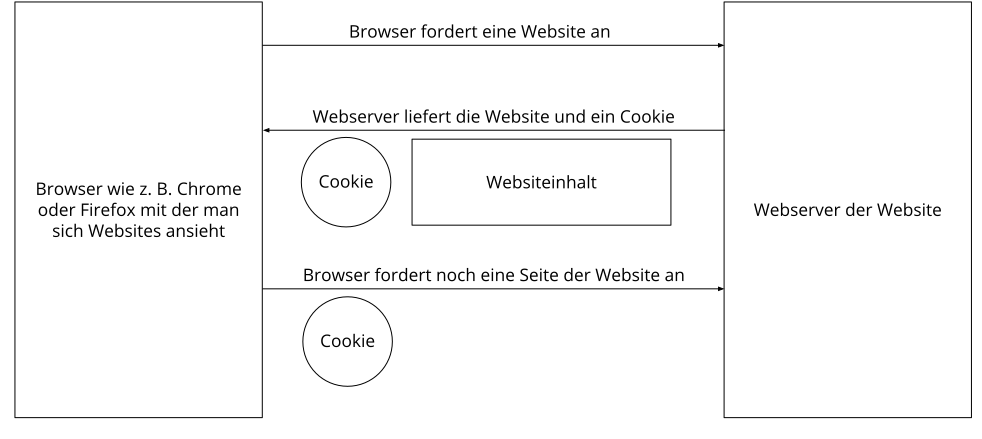
There are both first-party cookies and third-party cookies. First-party cookies are created directly by our site, third-party cookies are created by partner websites (e.g. Google Analytics). Each cookie must be evaluated individually because each cookie stores different data. The expiry time of a cookie also varies from a few minutes to a few years. Cookies are not software programs and do not contain viruses, Trojans or other “malicious” things. Cookies also cannot access information on your PC.
For example, cookie data might look like this:
Name: _ga
Value: GA1.2.1326744211.152113219170-9
Intended use: Differentiation of website visitors
Expiry date: after 2 years
A browser should be able to support these minimum sizes:
- At least 4096 bytes per cookie
- At least 50 cookies per domain
- At least 3000 cookies in total
What types of cookies are there?
The question of which cookies we use in particular depends on the services used and is clarified in the following sections of the data protection declaration. At this point we would like to briefly discuss the different types of HTTP cookies.
There are 4 types of cookies:
Essential cookies
These cookies are necessary to ensure basic functions of the website. For example, these cookies are needed when a user puts a product in the shopping cart, then continues surfing on other pages and only later checks out. These cookies do not delete the shopping cart, even if the user closes their browser window.
Purpose cookies
These cookies collect information about user behavior and whether the user receives any error messages. These cookies are also used to measure the loading time and behavior of the website on different browsers.
Target-oriented cookies
These cookies ensure a better user experience. For example, entered locations, font sizes or form data are saved.
Advertising cookies
These cookies are also called targeting cookies. They serve to provide the user with individually tailored advertising. This can be very practical, but also very annoying.
Typically, when you first visit a website, you will be asked which of these types of cookies you would like to allow. And of course this decision is also saved in a cookie.
If you want to know more about cookies and are not afraid of technical documentation, we recommend https://datatracker.ietf.org/doc/html/rfc6265, the Internet Engineering Task Force (IETF) Request for Comments called “HTTP State Management Mechanism”.
Purpose of processing via cookies
The purpose ultimately depends on the respective cookie. You can find more details about this below or from the manufacturer of the software that sets the cookie.
Which data is processed?
Cookies are little helpers for many different tasks. Unfortunately, it is not possible to generalize which data is stored in cookies, but we will inform you about the data processed or stored in the following data protection declaration.
Storage period of cookies
The storage period depends on the respective cookie and is further specified below. Some cookies are deleted after less than an hour, others can remain on a computer for several years.
You also have an influence on the storage period. You can delete all cookies manually at any time via your browser (see also “Right to object” below). Furthermore, cookies that are based on consent will be deleted at the latest after you revoke your consent, although the legality of storage remains unaffected until then.
Right to object – how can I delete cookies?
You decide for yourself how and whether you want to use cookies. Regardless of which service or website the cookies come from, you always have the option of deleting cookies, deactivating them or only partially allowing them. For example, you can block third-party cookies but allow all other cookies.
If you would like to find out which cookies have been stored in your browser, if you want to change or delete cookie settings, you can do this in your browser settings:
Chrome: Delete, enable and manage cookies in Chrome
Safari: Manage cookies and site data with Safari
Firefox: Delete cookies to remove data that websites have placed on your computer
Internet Explorer: Deleting and managing cookies Cookies
Microsoft Edge: Delete and managing cookies
If you generally do not want cookies, you can set your browser so that it always informs you when a cookie is to be set. This means you can decide for each individual cookie whether you allow the cookie or not. The procedure varies depending on the browser. The best thing to do is to search for the instructions in Google using the search term “delete cookies Chrome” or “deactivate cookies Chrome” in the case of a Chrome browser.
Legal basis
The so-called “Cookie Guidelines” have existed since 2009. This states that the storage of cookies requires your consent (Article 6 Para. 1 lit. a GDPR) from you. However, there are still very different reactions to these guidelines within the EU countries. In Austria, however, this directive was implemented in Section 165 Paragraph 3 of the Telecommunications Act (2021). In Germany, the cookie guidelines have not been implemented as national law. Instead, this directive was largely implemented in Section 15 Paragraph 3 of the Telemedia Act (TMG), which has been replaced by the Digital Services Act (DDG) since May 2024.
For absolutely necessary cookies, even if no consent has been given, there are legitimate interests (Article 6 Para. 1 lit. f GDPR), which in most cases are of an economic nature. We want to provide website visitors with a pleasant user experience and certain cookies are often absolutely necessary for this.
If non-essential cookies are used, this will only happen with your consent. The legal basis in this respect is Article 6 Paragraph 1 Letter a GDPR.
In the following sections you will be informed in more detail about the use of cookies if the software used uses cookies.
Web hosting introduction
|
Webhosting Zusammenfassung
👥 Betroffene: Besucher der Website 🤝 Zweck: professionelles Hosting der Website und Absicherung des Betriebs 📓 Verarbeitete Daten: IP-Adresse, Zeitpunkt des Websitebesuchs, verwendeter Browser und weitere Daten. Mehr Details dazu finden Sie weiter unten bzw. beim jeweils eingesetzten Webhosting Provider. 📅 Speicherdauer: abhängig vom jeweiligen Provider, aber in der Regel 2 Wochen ⚖️ Rechtsgrundlagen: Art. 6 Abs. 1 lit.f DSGVO (Berechtigte Interessen) |
What is web hosting?
When you visit websites these days, certain information - including personal data - is created and stored automatically, including on this website. This data should be processed as sparingly as possible and only with justification. By the way, by website we mean the entirety of all websites on a domain, i.e. everything from the start page (homepage) to the very last subpage (like this one). By domain we mean, for example, example.de or musterexample.com.
If you want to view a website on a computer, tablet, or smartphone, you use a program called a web browser. You probably know a few web browsers by name: Google Chrome, Microsoft Edge, Mozilla Firefox, and Apple Safari. We call it browser or web browser for short.
To display the website, the browser must connect to another computer where the website's code is stored: the web server. Operating a web server is a complicated and time-consuming task, which is why it is usually carried out by professional providers. These offer web hosting and thus ensure reliable and error-free storage of website data. A lot of technical terms, but please stay tuned, it gets better!
When the browser connects to your computer (desktop, laptop, tablet or smartphone) and during data transfer to and from the web server, personal data may be processed. On the one hand, your computer stores data, but on the other hand, the web server also needs to store data for a while to ensure proper operation.
A picture is worth a thousand words, so the following graphic shows the interaction between the browser, the Internet and the hosting provider.
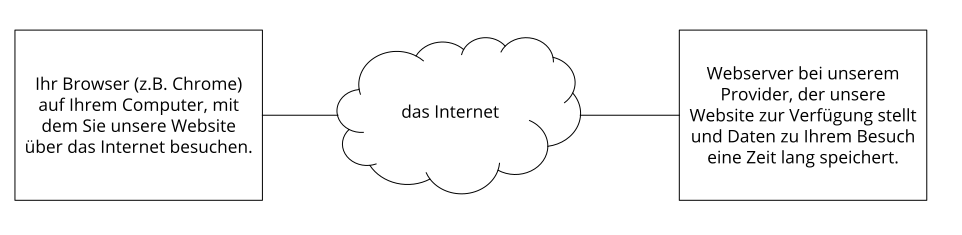
Why do we process personal data?
The purposes of data processing are:
- Professional website hosting and operational security
- to maintain operational and IT security
- Anonymous evaluation of access behavior to improve our offering and, if necessary, to prosecute or pursue claims
Which data is processed?
Even while you are visiting our website, our web server, which is the computer on which this website is stored, usually automatically saves data such as
- the complete internet address (URL) of the website accessed
- Browser and browser version (e.g. Chrome 87)
- the operating system used (e.g. Windows 10)
- the address (URL) of the previously visited page (referrer URL) (e.g. https://www.examplequellsite.de/vondabinichkommen/)
- the host name and IP address of the device from which access is made (e.g. COMPUTERNAME and 194.23.43.121)
- Date and time
- in files called web server log files
How long is data stored?
As a rule, the above-mentioned data is stored for two weeks and then automatically deleted. We do not pass on this data, but we cannot rule out that this data will be viewed by authorities if illegal behavior occurs.
In short: Your visit will be logged by our provider (company that runs our website on special computers (servers)), but we will not pass on your data without consent!
Legal basis
The legality of the processing of personal data in the context of web hosting results from Article 6 Paragraph 1 Letter f of the GDPR (protection of legitimate interests), because the use of professional hosting from a provider is necessary in order to present the company on the Internet in a secure and user-friendly manner and, if necessary, to be able to pursue attacks and claims resulting from this.
There is usually a contract for order processing between us and the hosting provider in accordance with Art. 28 f. GDPR, which ensures compliance with data protection and guarantees data security.
Web hosting provider external data protection declaration
Below you will find the contact details of our external hosting provider, where you can find out more about data processing in addition to the information above:
VPS Hoster Name:
Company name: CKStudio e.U.
Address: Am Straßfeld 1/1/6, 2401 Fischamend
Contact: info@ckstudio.at
Actual hosting provider:
easyname GmbH Canettistraße 5/10, 1100 Vienna, Austria
Email address: office@easyname.com
Telephone: 01 353 2222
You can find out more about data processing by this provider in the Data protection declaration.
Web Analytics Introduction
|
Web Analytics Datenschutzerklärung Zusammenfassung
👥 Betroffene: Besucher der Website 🤝 Zweck: Auswertung der Besucherinformationen zur Optimierung des Webangebots. 📓 Verarbeitete Daten: Zugriffsstatistiken, die Daten wie Standorte der Zugriffe, Gerätedaten, Zugriffsdauer und Zeitpunkt, Navigationsverhalten, Klickverhalten und IP-Adressen enthalten. Mehr Details dazu finden Sie beim jeweils eingesetzten Web Analytics Tool. 📅 Speicherdauer: abhängig vom eingesetzten Web-Analytics-Tool ⚖️ Rechtsgrundlagen: Art. 6 Abs. 1 lit. a DSGVO (Einwilligung), Art. 6 Abs. 1 lit. f DSGVO (Berechtigte Interessen) |
What is Web Analytics?
We use software on our website to evaluate the behavior of website visitors, known as web analytics for short. Data is collected, which the respective analytical tool provider (also called tracking tool) stores, manages and processes. The data is used to create analyzes of user behavior on our website and make them available to us as the website operator. In addition, most tools offer various testing options. For example, we can test which offers or content are best received by our visitors. We will show you two different offers for a limited period of time. After the test (so-called A/B test), we know which product or content our website visitors find more interesting. For such test procedures, as well as for other analytics procedures, user profiles can also be created and the data can be stored in cookies.
Why do we do web analytics?
We have a clear goal in mind with our website: we want to provide the best web offering on the market for our industry. In order to achieve this goal, we want to offer the best and most interesting offer on the one hand and, on the other hand, make sure that you feel completely comfortable on our website. With the help of web analysis tools, we can take a closer look at the behavior of our website visitors and then improve our website accordingly for you and us. For example, we can see how old our visitors are on average, where they come from, when our website is most visited or which content or products are particularly popular. All of this information helps us to optimize the website and thus best adapt it to your needs, interests and wishes.
Which data is processed?
Of course, exactly which data is stored depends on the analysis tools used. However, it is usually stored, for example, what content you view on our website, what buttons or links you click on, when you access a page, what browser you use, what device (PC, tablet, smartphone, etc.) you use to visit the website or what computer system you use. If you agreed that location data may also be collected, this can also be processed by the web analysis tool provider.
Your IP address is also stored. According to the General Data Protection Regulation (GDPR), IP addresses are personal data. However, your IP address is usually stored pseudonymously (i.e. in an unrecognizable and shortened form). For the purpose of testing, web analysis and web optimization, no direct data such as your name, age, address or email address is stored. All of this data, if collected, is stored pseudonymously. This means you cannot be identified as a person.
The following example shows schematically how Google Analytics works as an example of client-based web tracking with Java script code.
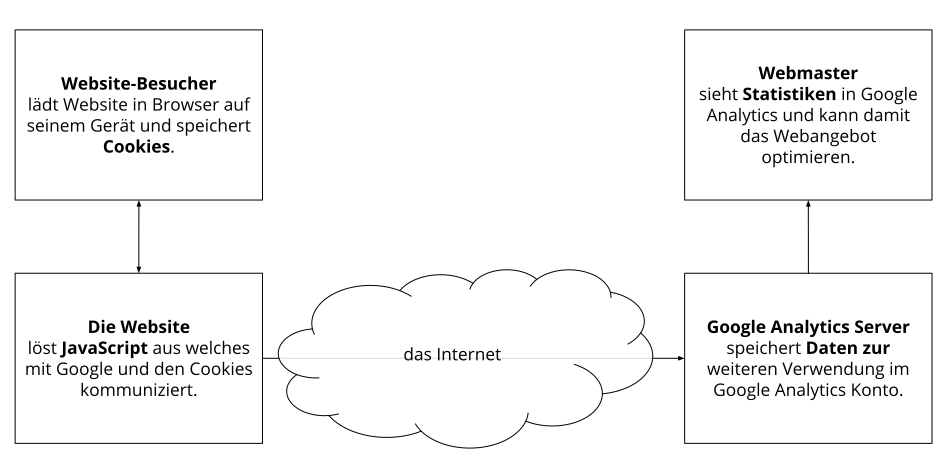
How long the respective data is stored always depends on the provider. Some cookies only store data for a few minutes or until you leave the website, other cookies can store data for several years.
Duration of data processing
We will inform you below about the duration of data processing if we have further information. In general, we only process personal data for as long as it is absolutely necessary to provide our services and products. If required by law, for example in the case of accounting, this storage period can also be exceeded.
Right to object
You also have the right and the opportunity to revoke your consent to the use of cookies or third-party providers at any time. This works either via our cookie management tool or via other opt-out functions. For example, you can also prevent data collection through cookies by managing, deactivating or deleting cookies in your browser.
Legal basis
The use of web analytics requires your consent, which we obtained with our cookie popup. According to Art. 6 Para. 1 lit.
In addition to consent, we have a legitimate interest in analyzing the behavior of website visitors and thus improving our offering technically and economically. With the help of web analytics, we detect website errors, identify attacks and improve profitability. The legal basis for this isArt. 6 para. 1 lit. f GDPR (legitimate interests). However, we only use the tools if you have given your consent.
Since cookies are used in web analytics tools, we also recommend that you read our general privacy policy on cookies. To find out exactly which of your data is stored and processed, you should read the data protection declarations of the respective tools.
Information about special web analytics tools, if available, can be found in the following sections.
Google Analytics privacy policy
|
Google Analytics Datenschutzerklärung Zusammenfassung
👥 Betroffene: Besucher der Website 🤝 Zweck: Auswertung der Besucherinformationen zur Optimierung des Webangebots. 📓 Verarbeitete Daten: Zugriffsstatistiken, die Daten wie Standorte der Zugriffe, Gerätedaten, Zugriffsdauer und Zeitpunkt, Navigationsverhalten und Klickverhalten enthalten. Mehr Details dazu finden Sie weiter unten in dieser Datenschutzerklärung. 📅 Speicherdauer: individuell einstellbar, standardmäßig speichert Google Analytics 4 Daten für 14 Monate ⚖️ Rechtsgrundlagen: Art. 6 Abs. 1 lit. a DSGVO (Einwilligung), Art. 6 Abs. 1 lit. f DSGVO (Berechtigte Interessen) |
What is Google Analytics?
On our website we use the analysis tracking tool Google Analytics in version Google Analytics 4 (GA4) from the American company Google Inc. For Europe, the company Google Ireland Limited (Gordon House, Barrow Street Dublin 4, Ireland) is responsible for all Google services. Google Analytics collects data about your actions on our website. Through the combination of different technologies such as cookies, device IDs and login information, you as a user can be identified across different devices. This means your actions can also be analyzed across platforms.
For example, if you click on a link, this event is stored in a cookie and sent to Google Analytics. The reports we receive from Google Analytics allow us to better tailor our website and service to your needs. Below we will go into more detail about the tracking tool and, above all, inform you about what data is processed and how you can prevent this.
Google Analytics is a tracking tool that is used to analyze traffic on our website. The basis of these measurements and analyzes is a pseudonymous user identification number. This number does not contain any personal data such as name or address, but is used to assign events to a device. GA4 uses an event-based model that captures detailed information about user interactions such as page views, clicks, scrolling, conversion events. In addition, various machine learning functions have been built into GA4 to better understand user behavior and certain trends. GA4 relies on modeling with the help of machine learning functions. This means that based on the data collected, missing data can also be extrapolated in order to optimize the analysis and also to be able to make forecasts.
In order for Google Analytics to work, a tracking code is built into the code of our website. When you visit our website, this code records various events that you perform on our website. With GA4's event-based data model, we as website operators can define and track specific events to obtain analysis of user interactions. In addition to general information such as clicks or page views, specific events that are important for our business can also be tracked. Such special events could be, for example, sending a contact form or purchasing a product.
As soon as you leave our website, this data is sent to the Google Analytics servers and stored there.
Google processes the data and we receive reports about your user behavior. These may include, among others, the following reports:
- Target group reports: Through target group reports we get to know our users better and know more precisely who is interested in our service.
- Display Reports: Display reports make it easier for us to analyze and improve our online advertising.
- Acquisition reports: Acquisition reports give us helpful information about how we can attract more people to our service.
- Behavioral reports: This is where we learn how you interact with our website. We can track the route you take on our site and which links you click on.
- Conversion reports: Conversion is the process in which you take a desired action based on a marketing message. For example, when you go from being just a website visitor to a buyer or newsletter subscriber. These reports help us learn more about how our marketing efforts are being received by you. This is how we want to increase our conversion rate.
- Real-time reports: Here we always find out immediately what is happening on our website. For example, we can see how many users are currently reading this text.
In addition to the analysis reports mentioned above, Google Analytics 4 also offers the following functions, among others:
- Event-based data model: This model captures very specific events that may occur on our website. For example, playing a video, purchasing a product or signing up for our newsletter.
- Advanced analytics features: These features allow us to better understand your behavior on our website or certain general trends. For example, we can segment user groups, carry out comparative analyzes of target groups or track your path on our website.
- Predictive modeling: Based on collected data, machine learning can extrapolate missing data that predicts future events and trends. This can help us develop better marketing strategies.
- Cross-platform analysis: Data collection and analysis is possible from both websites and apps. This gives us the opportunity to analyze user behavior across platforms, provided you have of course consented to data processing.
Why do we use Google Analytics on our website?
Our goal with this website is clear: we want to offer you the best possible service. The statistics and data from Google Analytics help us achieve this goal.
The statistically evaluated data shows us a clear picture of the strengths and weaknesses of our website. On the one hand, we can optimize our site so that interested people can find it more easily on Google. On the other hand, the data helps us to better understand you as a visitor. We therefore know exactly what we need to improve on our website in order to offer you the best possible service. The data also helps us to carry out our advertising and marketing measures more individually and cost-effectively. After all, it only makes sense to show our products and services to people who are interested in them.
What data does Google Analytics store?
Google Analytics creates a random, unique ID associated with your browser cookie using a tracking code. This is how Google Analytics recognizes you as a new user and you are assigned a user ID. The next time you visit our site, you will be recognized as a “returning” user. All collected data is stored together with this user ID. This makes it possible to evaluate pseudonymous user profiles.
In order to be able to analyze our website with Google Analytics, a property ID must be inserted into the tracking code. The data is then saved in the corresponding property. The Google Analytics 4 property is the default for every newly created property. Depending on the property used, data is stored for different lengths of time.
Using identifiers such as cookies, app instance IDs, user IDs or custom event parameters, your interactions are measured across platforms, provided you have consented. Interactions are all types of actions that you take on our website. If you also use other Google systems (such as a Google account), data generated via Google Analytics may be linked to third-party cookies. Google does not pass on Google Analytics data unless we as website operators authorize this. Exceptions may occur if required by law.
According to Google, Google Analytics 4 does not log or store IP addresses. However, Google uses the IP address data to derive location data and deletes it immediately afterwards. All IP addresses collected from users in the EU are deleted before the data is stored in a data center or on a server.
Because Google Analytics 4 focuses on event-based data, the tool uses significantly fewer cookies compared to previous versions (like Google Universal Analytics). However, there are some specific cookies used by GA4. These include, for example:
Name: _ga
Value: 2.1326744211.152113219170-5
Intended use: Used by default analytics.js uses the _ga cookie to store the user ID. Basically, it is used to distinguish website visitors.
Expiry date: after 2 years
Name: _gid
Value: 2.1687193234.152113219170-1
Purpose: The cookie also serves to distinguish website visitors
Expiry date: after 24 hours
Name: _gat_gtag_UA_<property-id>
Value: 1
Use: Used to reduce the request rate. If Google Analytics is provided via Google Tag Manager, this cookie is named _dc_gtm_ <property-id>.
Expiry date: after 1 minute
Note: This list cannot claim to be complete, as Google continually changes its choice of cookies. GA4 also aims to improve data protection. Therefore, the tool offers some options for controlling data collection. For example, we can set the storage period ourselves and also control data collection.
Here we show you an overview of the main types of data collected with Google Analytics:
Heatmaps: Google creates so-called heatmaps. Heatmaps show exactly the areas you click on. This gives us information about where you are on our site.
Session duration: Google refers to the time that you spend on our site without leaving the site. If you have been inactive for 20 minutes, the session ends automatically.
Bounce rate: A bounce is when you only view one page on our website and then leave our website again.
Account creation: If you create an account or place an order on our website, Google Analytics collects this data.
Location: IP addresses are not logged or stored in Google Analytics. However, shortly before the IP address is deleted, derivatives for location data are used.
Technical Information: Technical information includes, among other things, your browser type, your Internet provider or your screen resolution.
Source of origin: Google Analytics or we are of course also interested in which website or advertising you came to our site from.
Other data includes contact details, any reviews, playing media (e.g. when you play a video via our site), sharing content via social media or adding it to your favorites. The list does not claim to be complete and only serves as a general guide to data storage by Google Analytics.
How long and where is the data stored?
Google has their servers spread all over the world. You can read exactly where the Google data centers are located here: https://datacenters.google/
Your data is distributed on different physical storage media. This has the advantage that the data can be accessed more quickly and is better protected against manipulation. Every Google data center has appropriate emergency programs for your data. For example, if Google's hardware fails or natural disasters paralyze servers, the risk of service disruption at Google remains low.
The retention period of the data depends on the properties used. The storage period is always determined specifically for each individual property. Google Analytics offers us four options for controlling storage duration:
- 2 months: this is the shortest storage period.
- 14 months: By default, data is stored at GA4 for 14 months.
- 26 months: you can also save the data for 26 months.
- Data will not be deleted until we delete it manually
There is also the option that data will only be deleted if you no longer visit our website within the period chosen by us. In this case, the retention period will be reset each time you visit our website again within the specified period.
Once the specified period has expired, the data will be deleted once a month. This retention period applies to your data linked to cookies, user recognition and advertising IDs (e.g. cookies from the DoubleClick domain). Report results are based on aggregated data and are stored independently of user data. Aggregated data is a fusion of individual data into a larger unit.
How can I delete my data or prevent data storage?
Under European Union data protection law, you have the right to access, update, delete or restrict your data. You can use the browser add-on to deactivate Google Analytics JavaScript (analytics.js, gtag.js) to prevent Google Analytics 4 from using your data. You can download and install the browser add-on at https://tools.google.com/dlpage/gaoptout?hl=de. Please note that this add-on only deactivates data collection by Google Analytics.
If you generally want to deactivate, delete or manage cookies, you will find the relevant links to the relevant instructions for the most popular browsers under the “Cookies” section.
Legal basis
The use of Google Analytics requires your consent, which we obtained with our cookie popup. According to Art. 6 Para. 1 lit.
In addition to consent, we have a legitimate interest in analyzing the behavior of website visitors and thus improving our offering technically and economically. With the help of Google Analytics, we detect errors on the website, identify attacks and improve profitability. The legal basis for this isArt. 6 para. 1 lit. f GDPR (legitimate interests). However, we only use Google Analytics if you have given your consent.
Google also processes your data in the USA, among other places. Google is an active participant in the EU-US Data Privacy Framework, which regulates the correct and secure transfer of personal data from EU citizens to the USA. You can find more information about this at https://commission.europa.eu/document/fa09cbad-dd7d-4684-ae60-be03fcb0fddf_en.
Google also uses so-called standard contractual clauses (= Art. 46 Paragraphs 2 and 3 GDPR). Standard Contractual Clauses (SCC) are templates provided by the EU Commission and are intended to ensure that your data complies with European data protection standards even if it is transferred to third countries (such as the USA) and stored there. Through the EU-US Data Privacy Framework and the Standard Contractual Clauses, Google undertakes to comply with the European level of data protection when processing your relevant data, even if the data is stored, processed and managed in the USA. These clauses are based on an implementing decision of the EU Commission. You can find the resolution and the corresponding standard contractual clauses here: https://eur-lex.europa.eu/eli/dec_impl/2021/914/oj?locale=de
The Google Ads Data Processing Terms, which refer to the standard contractual clauses, can be found at https://business.safety.google/intl/de/adsprocessorterms/.
We hope we were able to provide you with the most important information about data processing by Google Analytics. If you want to find out more about the tracking service, we recommend these two links: https://marketingplatform.google.com/about/analytics/terms/de/ and https://support.google.com/analytics/answer/6004245?hl=de.
If you want to find out more about data processing, use the Google privacy policy at https://policies.google.com/privacy?hl=de.
Order processing agreement (AVV) Google Analytics
We have concluded an order processing agreement (AVV) with Google in accordance with Article 28 of the General Data Protection Regulation (GDPR). You can find out exactly what an AVV is and, above all, what must be contained in an AVV in our general section “Order Processing Agreement (AVV)”.
This contract is required by law because Google processes personal data on our behalf. This clarifies that Google may only process data that you receive from us according to our instructions and must comply with the GDPR. The link to the order data processing conditions can be found at https://business.safety.google/intl/de/adsprocessorterms/
Google Analytics reports on demographics and interests
We have activated the advertising reporting functions in Google Analytics. Demographics and interests reports include information about age, gender, and interests. This allows us to get a better picture of our users - without being able to assign this data to individual people. You can find out more about the advertising features at https://support.google.com/analytics/answer/3450482?hl=de_AT&utm_id=ad.
You can stop the use of the activities and information from your Google account under “Advertising Settings” on https://adssettings.google.com/authenticated by checking the box.
Google Analytics in consent mode
Depending on your consent, your personal data will be processed by Google Analytics in the so-called consent mode. You can choose whether or not to agree to Google Analytics cookies. This also allows you to choose which data Google Analytics may process from you. This collected data is primarily used to measure user behavior on the website, deliver targeted advertising and provide us with web analysis reports. As a rule, you consent to data processing by Google via a cookie consent tool. If you do not consent to data processing, only aggregated data will be collected and processed. This means that data cannot be assigned to individual users and no user profile is created for you. You can also just agree to the statistical measurement. No personal data is processed and therefore not used for advertising or advertising campaigns.
Google Analytics IP anonymization
We have implemented IP address anonymization from Google Analytics on this website. This function was developed by Google so that this website can comply with the applicable data protection regulations and recommendations of the local data protection authorities if they prohibit the storage of the full IP address. The anonymization or masking of the IP takes place as soon as the IP addresses arrive in the Google Analytics data collection network and before the data is stored or processed.
You can find more information about IP anonymization at https://support.google.com/analytics/answer/2763052?hl=de.
Google Optimize privacy policy
We use Google Optimize, a website optimization tool, on our website. The service provider is the American company Google Inc. For Europe, the company Google Ireland Limited (Gordon House, Barrow Street Dublin 4, Ireland) is responsible for all Google services.
Google also processes your data in the USA, among other places. Google is an active participant in the EU-US Data Privacy Framework, which regulates the correct and secure transfer of personal data from EU citizens to the USA. You can find more information about this at https://commission.europa.eu/document/fa09cbad-dd7d-4684-ae60-be03fcb0fddf_en.
Google also uses so-called standard contractual clauses (= Art. 46 Paragraphs 2 and 3 GDPR). Standard Contractual Clauses (SCC) are templates provided by the EU Commission and are intended to ensure that your data complies with European data protection standards even if it is transferred to third countries (such as the USA) and stored there. Through the EU-US Data Privacy Framework and the Standard Contractual Clauses, Google undertakes to comply with the European level of data protection when processing your relevant data, even if the data is stored, processed and managed in the USA. These clauses are based on an implementing decision of the EU Commission. You can find the resolution and the corresponding standard contractual clauses here: https://eur-lex.europa.eu/eli/dec_impl/2021/914/oj?locale=de
The Google Ads Data Processing Terms, which refer to the standard contractual clauses, can be found at https://business.safety.google/intl/de/adsprocessorterms/.
You can find out more about the data processed through the use of Google Optimize in the Privacy Policy at https://policies.google.com/privacy?hl=de.
Order processing agreement (AVV) Google Optimize
We have concluded an order processing agreement (AVV) with Google in accordance with Article 28 of the General Data Protection Regulation (GDPR). You can find out exactly what an AVV is and, above all, what must be contained in an AVV in our general section “Order Processing Agreement (AVV)”.
This contract is required by law because Google processes personal data on our behalf. This clarifies that Google may only process data that you receive from us according to our instructions and must comply with the GDPR. The link to the order data processing conditions can be found at https://business.safety.google/intl/de/adsprocessorterms/
Google Site Kit Privacy Policy
|
Google Site Kit Datenschutzerklärung Zusammenfassung
👥 Betroffene: Besucher der Website 🤝 Zweck: Auswertung der Besucherinformationen zur Optimierung des Webangebots. 📓 Verarbeitete Daten: Zugriffsstatistiken, die Daten wie Standorte der Zugriffe, Gerätedaten, Zugriffsdauer und Zeitpunkt, Navigationsverhalten, Klickverhalten und IP-Adressen enthalten. Mehr Details dazu finden weiter unten und in der Datenschutzerklärung von Google Analytics. 📅 Speicherdauer: abhängig von den verwendeten Properties ⚖️ Rechtsgrundlagen: Art. 6 Abs. 1 lit. a DSGVO (Einwilligung), Art. 6 Abs. 1 lit. f DSGVO (Berechtigte Interessen) |
What is Google Site Kit?
We have integrated the WordPress plugin Google Site Kit from the American company Google Inc. into our website. For Europe, Google Ireland Limited (Gordon House, Barrow Street Dublin 4, Ireland) is responsible for all Google services. With Google Site Kit we can quickly and easily view statistics that come from various Google products such as Google Analytics directly in our WordPress dashboard. The tool or the tools integrated into Google Site Kit also collect, among other things, personal data from you. In this data protection declaration we explain to you why we use Google Site Kit, how long and where data is stored and which other data protection texts are relevant to you in this context.
Google Site Kit is a plugin for the WordPress content management system. With this plugin we can view important website analysis statistics directly in our dashboard. These are statistics collected by other Google products. Above all from Google Analytics. In addition to Google Analytics, the services Google Search Console, Page Speed Insight, Google AdSense, Google Optimize and Google Tag Manager can also be linked to Google Site Kit.
Why do we use Google Site Kit on our website?
As a service provider, it is our job to offer you the best possible experience on our website. We want you to feel comfortable on our website and find exactly what you are looking for quickly and easily. Statistical evaluations help us to get to know you better and to adapt our offering to your wishes and interests. We use various Google tools for these evaluations. Site Kit makes our work a lot easier in this regard because we can view and analyze the statistics of Google products right in the dashboard. So we no longer have to register separately for the respective tool. Site Kit therefore always offers a good overview of the most important analysis data.
What data does Google Site Kit store?
If you have actively agreed to tracking tools in the cookie notice (also called script or banner), Google products such as Google Analytics will set cookies and data from you, such as your user behavior, will be sent to Google, stored and processed there. Personal data such as your IP address is also stored.
For more detailed information about the individual services, we have separate text sections in this data protection declaration. For example, see our Google Analytics privacy policy. Here we go into the collected data in great detail. You will find out how long Google Analytics stores, manages and processes data, which cookies can be used and how you can prevent data storage. We also have our own data protection declarations with comprehensive information for other Google services such as Google Tag Manager or Google AdSense.
Below we will show you example Google Analytics cookies that can be set in your browser provided you have fundamentally agreed to data processing by Google. Please note that these cookies are just a selection:
Name: _ga
Value:2.1326744211.152113219170-2
Intended use: Used by default analytics.js uses the _ga cookie to store the user ID. Basically, it is used to distinguish website visitors.
Expiry date: after 2 years
Name: _gid
Value:2.1687193234.152113219170-7
Purpose: Also this cookie is used to distinguish website visitors.
Expiry date: after 24 hours
Name: _gat_gtag_UA_<property-id>
Value: 1
Purpose: This cookie is used to reduce the request rate used.
Expiry date: after 1 minute
How long and where is the data stored?
Google stores collected data on its own Google servers, which are distributed worldwide. Most servers are located in the United States and therefore it is easy for your data to be stored there too. Visit https://datacenters.google/ to see exactly where the company provides servers.
Data collected by Google Analytics is stored for a standardized period of 26 months. Your user data will then be deleted. The retention period applies to all data linked to cookies, user recognition and advertising IDs.
How can I delete my data or prevent data storage?
You always have the right to receive information about your data, to have your data deleted, corrected or restricted. You can also deactivate, delete or manage cookies in your browser at any time.
If you generally want to deactivate, delete or manage cookies, you will find the relevant links to the relevant instructions for the most popular browsers under the “Cookies” section.
Legal basis
The use of Google Site Kit requires your consent, which we obtained with our cookie popup. According to Art. 6 Para. 1 lit.
In addition to consent, we have a legitimate interest in analyzing the behavior of website visitors and thus improving our offering technically and economically. With the help of Google Site Kit, we can detect website errors, identify attacks and improve profitability. The legal basis for this isArt. 6 para. 1 lit. f GDPR (legitimate interests). However, we only use Google Site Kit if you have given your consent.
Google also processes your data in the USA, among other places. Google is an active participant in the EU-US Data Privacy Framework, which regulates the correct and secure transfer of personal data from EU citizens to the USA. You can find more information about this at https://commission.europa.eu/document/fa09cbad-dd7d-4684-ae60-be03fcb0fddf_en.
Google also uses so-called standard contractual clauses (= Art. 46 Paragraphs 2 and 3 GDPR). Standard Contractual Clauses (SCC) are templates provided by the EU Commission and are intended to ensure that your data complies with European data protection standards even if it is transferred to third countries (such as the USA) and stored there. Through the EU-US Data Privacy Framework and the Standard Contractual Clauses, Google undertakes to comply with the European level of data protection when processing your relevant data, even if the data is stored, processed and managed in the USA. These clauses are based on an implementing decision of the EU Commission. You can find the resolution and the corresponding standard contractual clauses here: https://eur-lex.europa.eu/eli/dec_impl/2021/914/oj?locale=de
The Google Ads Data Processing Terms, which refer to the standard contractual clauses, can be found at https://business.safety.google/intl/de/adsprocessorterms/.
To find out more about Google's data processing, we recommend Google's comprehensive data protection guidelines at https://policies.google.com/privacy?hl=de.
Content Delivery Networks Introduction
|
Content Delivery Networks Datenschutzerklärung Zusammenfassung
👥 Betroffene: Besucher der Website 🤝 Zweck: Optimierung unserer Serviceleistung (um die Website schneller laden zu können) 📓 Verarbeitete Daten: Daten wie etwa Ihre IP-Adresse Mehr Details dazu finden Sie weiter unten und den einzelnen Datenschutztexten. 📅 Speicherdauer: meisten werden die Daten solange gespeichert, bis sie zur Erfüllung der Dienstleistung nicht mehr benötigt werden ⚖️ Rechtsgrundlagen: Art. 6 Abs. 1 lit. a DSGVO (Einwilligung), Art. 6 Abs. 1 lit. f DSGVO (Berechtigte Interessen) |
What is a Content Delivery Network?
We use a so-called content delivery network on our website. Most often such a network is just called a CDN. A CDN helps us load our website quickly and easily, regardless of your location. Your personal data is also stored, managed and processed on the servers of the CDN provider used. Below we will go into more general detail about the service and its data processing. You can find detailed information about how your data is handled in the provider’s respective data protection declaration.
Any Content Delivery Network (CDN) is a network of regionally distributed servers, all connected to each other via the Internet. Website content (especially very large files) can be delivered quickly and smoothly via this network, even during large peak loads. The CDN creates a copy of our website on your servers. Since these servers are distributed worldwide, the website can be delivered quickly. The data transmission to your browser is therefore significantly shortened by the CDN.
Why do we use a Content Delivery Network for our website?
A fast-loading website is part of our service. Of course, we know how annoying it is when a website loads at a snail's pace. Most of the time you even lose patience and run away before the website is fully loaded. Of course we want to avoid that. Therefore, a fast-loading website is a natural part of our website offering. With a content delivery network, our website loads significantly faster in your browser. Using the CDN is particularly helpful if you are abroad because the website is delivered from a server near you.
Which data is processed?
When you request a website or the content of a website and it is cached in a CDN, the CDN routes the request to the server closest to you and this server delivers the content. Content Delivery Networks are built to allow JavaScript libraries to be downloaded and hosted on npm and Github servers. Alternatively, WordPress plugins can also be loaded on most CDNs if they are hosted on WordPress.org. Your browser may send personal data to the content delivery network we use. This includes data such as IP address, browser type, browser version, which website is loaded or the time and date of the page visit. This data is collected and stored by the CDN. Whether cookies are used to store data depends on the network used. Please read the data protection texts of the respective service.
Right to object
If you want to completely prevent this data transfer, you can install a JavaScript blocker (see for example https://noscript.net/) on your PC. Of course, our website can no longer offer the usual service (such as fast loading speeds).
Legal basis
If you have consented to the use of a content delivery network, the legal basis for the corresponding data processing is this consent. According toArt. 6 Para. 1 lit. a GDPR (consent) represents the legal basis for the processing of personal data, as may occur when collected by a content delivery network.
We also have a legitimate interest in using a content delivery network to optimize our online service and make it more secure. The corresponding legal basis for this isArt. 6 para. 1 lit. f GDPR (legitimate interests). However, we only use the tool if you have given your consent.
Information about special content delivery networks - if available - can be found in the following sections.
BootstrapCDN Privacy Policy
|
BootstrapCDN Datenschutzerklärung Zusammenfassung
👥 Betroffene: Besucher der Website 🤝 Zweck: Optimierung unserer Serviceleistung (um die Website schneller laden zu können) 📓 Verarbeitete Daten: Daten wie etwa Ihre IP-Adresse, Browsertyp, Browserversion, welche Webseite geladen wird oder Uhrzeit und Datum des Seitenbesuchs Mehr Details dazu finden Sie weiter unten in dieser Datenschutzerklärung. 📅 Speicherdauer: meisten werden die Daten solange gespeichert, bis sie zur Erfüllung der Dienstleistung nicht mehr benötigt werden ⚖️ Rechtsgrundlagen: Art. 6 Abs. 1 lit. a DSGVO (Einwilligung), Art. 6 Abs. 1 lit. f DSGVO (Berechtigte Interessen) |
What is BootstrapCDN?
In order to be able to deliver all of our individual web pages (subpages of our website) to you quickly and securely on all devices, we use the content delivery network (CDN) BootstrapCDN, an open source service from jsdelivr.com of the Polish software company ProspectOne, Królewska 65A/1, 30-081, Kraków, Poland. A content delivery network (CDN) is a network of regionally distributed servers connected to each other via the Internet. This network allows content, especially very large files, to be delivered quickly, even during large peak loads.
Why do we use BootstrapCDN?
Of course, we want to offer you a comprehensive and well-functioning service with our website. This also includes a fast website. With jsdelivr.com CDN our website can load much faster for you. The use of jsdelivr.com CDN is particularly helpful for users from abroad, as the site can be delivered from a nearby server.
What data is processed by BootstrapCDN?
BootstrapCDN works by delivering so-called JavaScript libraries to your browser. If your browser now downloads a file from BootstrapCDN, your IP address will be transmitted to the Bootstrap CDN server during the connection. Personal data can also be sent and stored. BootstrapCDN can therefore collect and store user data such as IP address, browser type, browser version, which website is loaded or the time and date of the page visit. The privacy policy of BootstrapCDN or jsdelivr.com expressly states that the company does not use cookies or other tracking services.
How long and where is the data stored?
BootstrapCDN has servers distributed in different countries and your data may also be stored outside the European Economic Area. BootstrapCDN retains personal data processed on our behalf for as long as necessary to provide the services offered, to comply with legal obligations, to resolve disputes and to enforce the agreements.
Right to object
You always have the right to information, correction and deletion of your personal data. If you have any questions, you can contact those responsible at BootstrapCDN at any time.
If you want to prevent this data transfer, you can install a JavaScript blocker (see for example https://noscript.net/) or deactivate the execution of JavaScript codes in your browser. Please note, however, that this means the website can no longer offer the usual service (such as fast loading speeds).
Legal basis
If you have consented to BootstrapCDN being used, the legal basis for the corresponding data processing is this consent. According to Art. 6 Para. 1 lit.
We also have a legitimate interest in using BootstrapCDN to optimize our online service and make it more secure. The corresponding legal basis for this isArt. 6 para. 1 lit. f GDPR (legitimate interests). However, we only use BootstrapCDN if you have given your consent.
We would like to point out that, according to the European Court of Justice, there is currently no adequate level of protection for data transfer to the USA. Data processing is essentially done by BootstrapCDN. This can result in data not being processed and stored anonymously. Furthermore, US government authorities may have access to individual data. It may also happen that this data is linked to data from other BootstrapCDN services where you have a user account.
You can find more information about data protection at BootstrapCDN at https://www.jsdelivr.com/terms/privacy-policy-jsdelivr-net.
Cloudflare privacy policy
|
Cloudflare Datenschutzerklärung Zusammenfassung
👥 Betroffene: Besucher der Website 🤝 Zweck: Optimierung unserer Serviceleistung (um die Website schneller laden zu können) 📓 Verarbeitete Daten: Daten wie etwa IP-Adresse, Kontakt- und Protokollinfos, Sicherheitsfingerabdrücke und Leistungsdaten für Websites Mehr Details dazu finden Sie weiter unten in dieser Datenschutzerklärung. 📅 Speicherdauer: meisten werden die Daten für weniger als 24 Stunden gespeichert ⚖️ Rechtsgrundlagen: Art. 6 Abs. 1 lit. a DSGVO (Einwilligung), Art. 6 Abs. 1 lit. f DSGVO (Berechtigte Interessen) |
What is Cloudflare?
We use Cloudflare from Cloudflare, Inc. (101 Townsend St., San Francisco, CA 94107, USA) on this website to make our website faster and more secure. Cloudflare uses cookies and processes user data. Cloudflare, Inc. is an American company that offers a content delivery network and various security services. These services are between the user and our hosting provider. We will try to explain in more detail what this all means below.
A content delivery network (CDN), like the one provided by Cloudflare, is nothing more than a network of connected servers. Cloudflare has servers like this distributed around the world to get websites to your screen faster. To put it simply, Cloudflare creates copies of our website and places them on their own servers. When you now visit our website, a load balancing system ensures that the largest parts of our website are delivered from the server that can display our website to you the fastest. The data transmission route to your browser is significantly shortened by a CDN. This means that the content of our website is delivered to you by Cloudflare not only from our hosting server, but from servers from all over the world. The use of Cloudflare is particularly helpful for users from abroad, as the site can be delivered from a nearby server. In addition to quickly delivering websites, Cloudflare also offers various security services such as DDoS protection or the web application firewall.
Why do we use Cloudflare on our website?
Of course we want to offer you the best possible service with our website. Cloudflare helps us make our website faster and more secure. Cloudflare offers us both web optimization and security services such as DDoS protection and web firewall. This also includes a reverse proxy and the content distribution network (CDN). Cloudflare blocks threats and limits abusive bots and crawlers that waste our bandwidth and server resources. By storing our website on local data centers and blocking spam software, Cloudflare allows us to reduce our bandwidth usage by approximately 60%. Serving content from a data center near you and doing some web optimization there reduces the average load time of a web page by about half. According to Cloudflare, the "I'm Under Attack Mode" setting can be used to mitigate further attacks by displaying a JavaScript calculation task that must be solved before a user can access a website. Overall, this makes our website significantly more powerful and less susceptible to spam or other attacks.
What data does Cloudflare process?
Cloudflare generally only forwards data that is controlled by website operators. The content is therefore not determined by Cloudflare, but always by the website operator itself. In addition, Cloudflare may collect certain information about the use of our website and process data that is sent by us or for which Cloudflare has received corresponding instructions. In most cases, Cloudflare receives data such as IP address, contact and log information, security fingerprints, and website performance data. For example, log data helps Cloudflare detect new threats. This allows Cloudflare to ensure a high level of security protection for our website. Cloudflare processes this data as part of the Services in compliance with applicable laws. Of course, this also includes the General Data Protection Regulation (GDPR). Cloudflare also works with third parties. They may only process personal data under the instructions of Cloudflare and in accordance with the data protection guidelines and other confidentiality and security measures. Cloudflare will not pass on any personal data without our explicit consent.
How long and where is the data stored?
Cloudflare stores your information primarily in the United States and the European Economic Area. Cloudflare may transfer and access the information described above from anywhere in the world. Generally, Cloudflare stores user-level data for Free, Pro, and Business domains for less than 24 hours. For enterprise domains that have Cloudflare Logs (formerly Enterprise LogShare or ELS) enabled, data can be stored for up to 7 days. However, if IP addresses trigger security warnings at Cloudflare, there may be exceptions to the storage period listed above.
How can I delete my data or prevent data storage?
Cloudflare only retains data logs for as long as necessary and in most cases this data is deleted within 24 hours. Cloudflare also does not store any personal data, such as your IP address. However, there is information that Cloudflare stores indefinitely as part of its persistent logs to improve the overall performance of Cloudflare Resolver and detect any security risks. You can find out exactly which permanent logs are stored at https://www.cloudflare.com/application/privacypolicy/. All data that Cloudflare collects (temporary or permanent) is purged of any personal information. All permanent logs are also anonymized by Cloudflare.
Cloudflare states in their privacy policy that they are not responsible for the content they receive. For example, if you ask Cloudflare whether they can update or delete your content, Cloudflare generally refers to us as the website operator. You can also completely prevent all collection and processing of your data by Cloudflare by deactivating the execution of script code in your browser or by integrating a script blocker into your browser.
Legal basis
If you have consented to Cloudflare being used, the legal basis for the corresponding data processing is this consent. According to Art. 6 Para. 1 lit.
We also have a legitimate interest in using Cloudflare to optimize our online service and make it more secure. The corresponding legal basis for this isArt. 6 para. 1 lit. f GDPR (legitimate interests). However, we only use Cloudflare if you have given your consent.
Cloudflare also processes your data in the USA, among other places. Cloudflare is an active participant in the EU-US Data Privacy Framework, which regulates the correct and secure transfer of personal data from EU citizens to the USA. You can find more information about this at https://commission.europa.eu/document/fa09cbad-dd7d-4684-ae60-be03fcb0fddf_en.
Cloudflare also uses so-called standard contractual clauses (= Art. 46 Paragraphs 2 and 3 GDPR). Standard Contractual Clauses (SCC) are templates provided by the EU Commission and are intended to ensure that your data complies with European data protection standards even if it is transferred to third countries (such as the USA) and stored there. Through the EU-US Data Privacy Framework and the Standard Contractual Clauses, Cloudflare undertakes to comply with European data protection levels when processing your relevant data, even if the data is stored, processed and managed in the USA. These clauses are based on an implementing decision of the EU Commission. You can find the resolution and the corresponding standard contractual clauses here: https://eur-lex.europa.eu/eli/dec_impl/2021/914/oj?locale=de.
You can find out more about the standard contractual clauses and data processed through the use of Cloudflare in the privacy policy at https://www.cloudflare.com/de-de/privacypolicy/.
jQuery CDN privacy policy
|
jQuery CDN Datenschutzerklärung Zusammenfassung
👥 Betroffene: Besucher der Website 🤝 Zweck: Optimierung unserer Serviceleistung (um die Website schneller laden zu können) 📓 Verarbeitete Daten: Daten wie etwa Ihre IP-Adresse Mehr Details dazu finden Sie weiter unten in dieser Datenschutzerklärung. 📅 Speicherdauer: meisten werden die Daten solange gespeichert, bis sie zur Erfüllung der Dienstleistung nicht mehr benötigt werden ⚖️ Rechtsgrundlagen: Art. 6 Abs. 1 lit. a DSGVO (Einwilligung), Art. 6 Abs. 1 lit. f DSGVO (Berechtigte Interessen) |
What is jQuery?
In order to deliver our website or jQuery library to you quickly and easily on different devices, we use jQuery CDN services from the OpenJS Foundation company. jQuery is distributed via the Content Delivery Network (CDN) of the American software company Fastly, Inc. (475 Brannan St, Suite 300 San Francisco, CA 94107, USA). This service stores, manages and processes your personal data. In this data protection declaration we go into more detail about which data about you is processed through the use of jQuery CDN.
A content delivery network (CDN) is a network of regionally distributed servers connected to each other via the Internet. This network allows content, especially very large files, to be delivered quickly, even during large peak loads. jQuery creates a copy of our website on its servers. This means our website can be delivered as quickly as possible. This means that the data transfer to your browser is shortened by a CDN.
Why do we use jQuery on our website?
Of course, we want to offer you a comprehensive and well-functioning service with our website. This also includes a fast website. With jQuery our website can load much faster. The use of jQuery CDN is particularly helpful for users from abroad, as the site can be delivered from a nearby server.
What data is processed by jQuery?
jQuery uses JavaScript libraries to deliver our website content quickly. A CDN server loads the necessary files. As soon as a connection to the CDN server is established, your IP address is recorded and stored. This only happens if this data is not already stored in your browser from a previous website visit.
How long and where is the data stored?
jQuery or Fastly has servers distributed in different countries and your data can therefore be stored in both America and the European Economic Area. Fastly retains personal data processed on our behalf for as long as necessary to provide the services offered, to comply with legal obligations, to resolve disputes and to enforce the agreements.
Right to object
You always have the right to information, correction and deletion of your personal data. If you have any questions, you can contact those responsible at jQuery at any time.
If you don't want data to be transferred, you always have the option of using Java script blockers such as https://www.ghostery.com/ or noscript.net to install. You can also simply deactivate the execution of JavaScript codes in your browser. If you decide to deactivate JavaScript codes, the usual functions will also change. For example, a website no longer loads as quickly.
Legal basis
If you have consented to jQuery CDN being used, the legal basis for the corresponding data processing is this consent. According toArticle 6 Paragraph 1 lit.
We also have a legitimate interest in using jQuery CDN to optimize our online service and make it more secure. The corresponding legal basis for this isArt. 6 para. 1 lit. f GDPR (legitimate interests). However, we only use the tool if you have given your consent.
Fastly also processes your data in the USA, among other places. Fastly is an active participant in the EU-US Data Privacy Framework, which regulates the correct and secure transfer of personal data from EU citizens to the USA. You can find more information about this at https://commission.europa.eu/document/fa09cbad-dd7d-4684-ae60-be03fcb0fddf_en.
Fastly also uses so-called standard contractual clauses (= Art. 46 Paragraphs 2 and 3 GDPR). Standard Contractual Clauses (SCC) are templates provided by the EU Commission and are intended to ensure that your data complies with European data protection standards even if it is transferred to third countries (such as the USA) and stored there. Through the EU-US Data Privacy Framework and the Standard Contractual Clauses, Fastly undertakes to comply with European data protection levels when processing your relevant data, even if the data is stored, processed and managed in the USA. These clauses are based on an implementing decision of the EU Commission. You can find the resolution and the corresponding standard contractual clauses here: https://eur-lex.europa.eu/eli/dec_impl/2021/914/oj?locale=de.
The Fastly Data Protection Terms, which correspond to the standard contractual clauses, can be found at https://www.fastly.com/data-processing/.
You can find more information about data protection at Fastly at https://www.fastly.com/privacy/ and about jQuery at https://images.prismic.io/openjsf/ba00b254-685f-4e54-b1ca-17984b0f3e55_OpenJS-Foundation-Privacy-Policy-2019-11-15.pdf.
jsdelivr.com CDN Privacy Policy
|
jsdelivr.com-CDN Datenschutzerklärung Zusammenfassung
👥 Betroffene: Besucher der Website 🤝 Zweck: Optimierung unserer Serviceleistung (um die Website schneller laden zu können) 📓 Verarbeitete Daten: Daten wie etwa Ihre IP-Adresse, Browsertyp, Browserversion, welche Webseite geladen wird oder Uhrzeit und Datum des Seitenbesuchs Mehr Details dazu finden Sie weiter unten in dieser Datenschutzerklärung. 📅 Speicherdauer: meisten werden die Daten solange gespeichert, bis sie zur Erfüllung der Dienstleistung nicht mehr benötigt werden ⚖️ Rechtsgrundlagen: Art. 6 Abs. 1 lit. a DSGVO (Einwilligung), Art. 6 Abs. 1 lit. f DSGVO (Berechtigte Interessen) |
What is jsdelivr.com CDN?
So that we can deliver our individual websites to you quickly and flawlessly on all different devices, we use the open source services of jsdelivr.com of the Polish software company ProspectOne, Królewska 65A/1, 30-081, Kraków, Poland. This is a Content Delivery Network (CDN). This is a network of regionally distributed servers connected via the Internet. This means that content, especially large files, can be delivered quickly and optimally, even during large peak loads.
Why do we use jsdelivr.com CDN?
Of course, we want to offer you a comprehensive and well-functioning service with our website. This also includes a fast website. With jsdelivr.com CDN our website can load much faster for you. The use of jsdelivr.com CDN is particularly helpful for users from abroad, as the site can be delivered from a nearby server.
What data is processed by jsdelivr.com CDN?
jsDelivr is built to download JavaScript libraries hosted on npm and Github servers. However, WordPress plugins can also be loaded as long as they are hosted on WordPress.org. In order to provide this service, your browser may send personal information to jsdelivr.com. jsDelivr can therefore collect and store user data such as IP address, browser type, browser version, which website is loaded or the time and date of the page visit. jsdelivr.com's privacy policy expressly states that the company does not use cookies or other tracking services.
How long and where is the data stored?
jsDelivr has servers distributed in different countries and your data may also be stored outside the European Economic Area. jsDelivr retains personal data processed on our behalf for as long as necessary to provide the services offered, to comply with legal obligations, to resolve disputes and to enforce the agreements.
Right to object
You always have the right to information, correction and deletion of your personal data. If you have any questions, you can also contact those responsible at jsdelivr.com-CDN at any time.
If you want to prevent this data transfer, you can install a JavaScript blocker (see for example https://noscript.net/). Please note, however, that this means the website can no longer offer the usual service (such as fast loading speeds).
Legal basis
If you have consented to jsdelivr.com CDN being used, the legal basis for the corresponding data processing is this consent. According to Art. 6 Para. 1 lit.
We also have a legitimate interest in using jsdelivr.com CDN to optimize our online service and make it more secure. The corresponding legal basis for this isArt. 6 para. 1 lit. f GDPR (legitimate interests). However, we only use the tool if you have given your consent.
Further information on data processing by the jsDelivr software service can be found in the company's privacy policy at https://www.jsdelivr.com/terms/privacy-policy-jsdelivr-net.
Cookie Consent Management Platform Introduction
|
Cookie Consent Management Platform Zusammenfassung
👥 Betroffene: Website Besucher 🤝 Zweck: Einholung und Verwaltung der Zustimmung zu bestimmten Cookies und somit dem Einsatz bestimmter Tools 📓 Verarbeitete Daten: Daten zur Verwaltung der eingestellten Cookie-Einstellungen wie IP-Adresse, Zeitpunkt der Zustimmung, Art der Zustimmung, einzelne Zustimmungen. Mehr Details dazu finden Sie beim jeweils eingesetzten Tool. 📅 Speicherdauer: Hängt vom eingesetzten Tool ab, man muss sich auf Zeiträume von mehreren Jahren einstellen ⚖️ Rechtsgrundlagen: Art. 6 Abs. 1 lit. a DSGVO (Einwilligung), Art. 6 Abs. 1 lit.f DSGVO (berechtigte Interessen) |
What is a Cookie Consent Management Platform?
We use Consent Management Platform (CMP) software on our website, which makes it easier for us and you to handle the scripts and cookies used correctly and safely. The software automatically creates a cookie popup, scans and controls all scripts and cookies, provides you with the cookie consent required by data protection law and helps us and you to keep track of all cookies. Most cookie consent management tools identify and categorize all existing cookies. As a website visitor, you then decide for yourself whether and which scripts and cookies you allow or disallow. The following graphic shows the relationship between browser, web server and CMP.
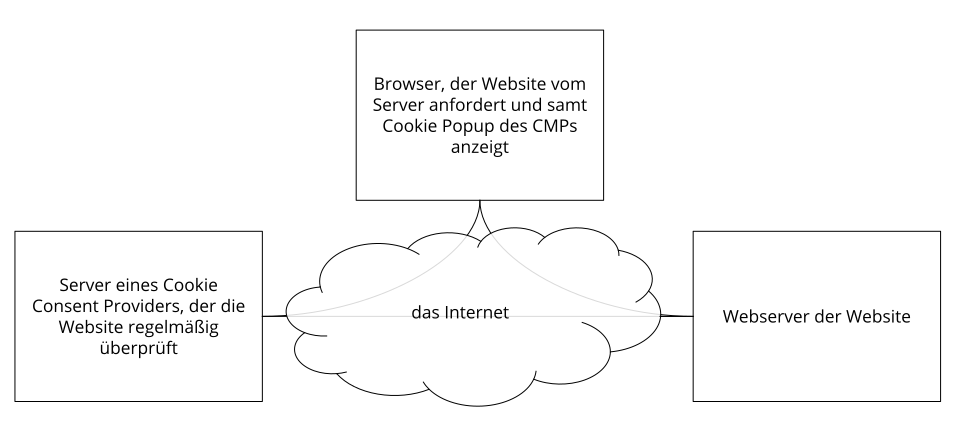
Why do we use a cookie management tool?
Our goal is to offer you the best possible transparency in the area of data protection. We are also legally obliged to do so. We want to inform you as much as possible about all the tools and all the cookies that can store and process your data. It is also your right to decide for yourself which cookies you accept and which you do not. In order to grant you this right, we must first know exactly which cookies ended up on our website. Thanks to a cookie management tool that regularly scans the website for all existing cookies, we know about all cookies and can provide you with GDPR-compliant information about them. You can then accept or reject cookies via the consent system.
Which data is processed?
As part of our cookie management tool, you can manage each individual cookie yourself and have complete control over the storage and processing of your data. The declaration of your consent will be saved so that we do not have to ask you every time you visit our website and we can also prove your consent if legally required. This is stored either in an opt-in cookie or on a server. Depending on the provider of the cookie management tool, the storage period for your cookie consent varies. This data (such as pseudonymous user ID, time of consent, detailed information on cookie categories or tools, browser, device information) is usually stored for up to two years.
Duration of data processing
We will inform you below about the duration of data processing if we have further information. In general, we only process personal data for as long as it is absolutely necessary to provide our services and products. Data stored in cookies is stored for different lengths of time. Some cookies are deleted after you leave the website, others can be stored in your browser for several years. The exact duration of data processing depends on the tool used; in most cases you should be prepared for a storage period of several years. You will usually receive detailed information about the duration of data processing in the respective data protection declarations of the individual providers.
Right to object
You also have the right and the opportunity to revoke your consent to the use of cookies at any time. This works either via our cookie management tool or via other opt-out functions. For example, you can also prevent data collection through cookies by managing, deactivating or deleting cookies in your browser.
Information about special cookie management tools, if available, can be found in the following sections.
Legal basis
If you agree to cookies, your personal data will be processed and stored via these cookies. If we are allowed to use cookies based on your consent (Article 6 Para. 1 lit. a GDPR), this consent is also the legal basis for the use of cookies or the processing of your data. In order to be able to manage the consent to cookies and to enable you to give your consent, a cookie consent management platform software is used. The use of this software enables us to operate the website in an efficient and legally compliant manner, which represents a legitimate interest (Article 6 (1) (f) GDPR).
Cookiebot privacy policy
|
Cookiebot Datenschutzerklärung Zusammenfassung
👥 Betroffene: Website Besucher 🤝 Zweck: Einholung der Zustimmung zu bestimmten Cookies und somit dem Einsatz bestimmter Tools 📓 Verarbeitete Daten: Daten zur Verwaltung der eingestellten Cookie-Einstellungen wie IP-Adresse, Zeitpunkt der Zustimmung, Art der Zustimmung, einzelne Zustimmungen. Mehr Details dazu finden Sie beim jeweils eingesetzten Tool. 📅 Speicherdauer: die Daten werden nach einem Jahr gelöscht ⚖️ Rechtsgrundlagen: Art. 6 Abs. 1 lit. a DSGVO (Einwilligung), Art. 6 Abs. 1 lit.f DSGVO (berechtigte Interessen) |
What is Cookiebot?
We use functions from the provider Cookiebot on our website. The company behind Cookiebot is Cybot A/S, Havnegade 39, 1058 Copenhagen, DK. Cookiebot offers us, among other things, the opportunity to provide you with a comprehensive cookie notice (also called cookie banner or cookie notice). By using this function, data from you can be sent to Cookiebot or Cybot, stored and processed. In this data protection declaration we inform you why we use Cookiebot, what data is transferred and how you can prevent this data transfer.
Cookiebot is a software product from the company Cybot. The software automatically creates a GDPR-compliant cookie notice for our website visitors. In addition, the technology behind Cookiebot scans, controls and evaluates all cookies and tracking measures on our website.
Why do we use Cookiebot on our website?
We take data protection very seriously. We want to show you exactly what is going on on our website and which of your data is stored. Cookiebot helps us to get a good overview of all our cookies (first and third party cookies). This allows us to inform you precisely and transparently about the use of cookies on our website. You always receive an up-to-date and data protection-compliant cookie notice and you decide for yourself which cookies you allow and which not.
What data is stored by Cookiebot?
If you allow cookies, the following data will be transferred to Cybot, stored and processed.
- IP address (in anonymized form, the last 3 digits are set to 0)
- Date and time of your consent
- our website URL
- technical browser data
- encrypted, anonymous key
- the cookies you have allowed (as proof of consent)
The following cookies are set by Cookiebot if you have agreed to the use of cookies:
Name: CookieConsent
Value: {stamp:’P7to4eNgIHvJvDerjKneBsmJQd9113219170-2
Purpose: This cookie stores your consent status. This allows our website to read and follow the current status on future visits.
Expiry date: after one year
Name: CookieConsentBulkTicket
Value: kDSPWpA%2fjhljZKClPqsncfR8SveTnNWhys5NojaxdFYBPjZ2PaDnUw%3d%3113219170-6
Purpose: This cookie is set if you allow all cookies and have therefore activated “collective consent”. The cookie then stores its own, random and unique ID.
Expiry date: after one year
Note: Please remember that this is an exemplary list and we cannot claim to be complete. In the cookie declaration at https://www.cookiebot.com/de/cookie-declaration/ you can see which other cookies can be used.
According to Cybot's privacy policy, the company does not sell personal information. However, Cybot passes on data to trusted third parties or subcontractors who help the company achieve its own business goals. Data will also be passed on if this is legally required.
How long and where is the data stored?
All data collected is transferred, stored and forwarded exclusively within the European Union. The data is stored in an Azure data center (cloud provider is Microsoft). You can find out more about all “Azure regions” at https://azure.microsoft.com/de-de/explore/global-infrastructure/geographies/. All user data will be deleted by Cookiebot after 12 months from registration (cookie consent) or immediately after termination of the Cookiebot service.
How can I delete my data or prevent data storage?
You have the right to access and delete your personal data at any time. You can prevent data collection and storage, for example, by rejecting the use of cookies via the cookie notice. Your browser offers another option to prevent data processing or to manage it according to your wishes. Depending on the browser, cookie management works slightly differently. Under the “Cookies” section you will find the corresponding links to the relevant instructions for the most popular browsers.
Legal basis
If you agree to cookies, your personal data will be processed and stored via these cookies. If we are allowed to use cookies based on your consent (Article 6 Para. 1 lit. a GDPR), this consent is also the legal basis for the use of cookies or the processing of your data. In order to be able to manage the consent to cookies and to enable you to give your consent, the Cookiebot is used. The use of this software enables us to operate the website in an efficient and legally compliant manner, which represents a legitimate interest (Article 6 (1) (f) GDPR).
If you would like to find out more about the privacy policy of “Cookiebot” or the company Cybot behind it, we recommend the privacy policy at https://www.cookiebot.com/de/privacy-policy/ to read through.
Security & Anti spam
|
Security & Anti-Spam Datenschutzerklärung Zusammenfassung
👥 Betroffene: Besucher der Website 🤝 Zweck: Cybersicherheit 📓 Verarbeitete Daten: Daten wie etwa Ihre IP-Adresse, Name oder technische Daten wie etwa Browserversion Mehr Details dazu finden Sie weiter unten und den einzelnen Datenschutztexten. 📅 Speicherdauer: meisten werden die Daten solange gespeichert, bis sie zur Erfüllung der Dienstleistung nicht mehr benötigt werden ⚖️ Rechtsgrundlagen: Art. 6 Abs. 1 lit. a DSGVO (Einwilligung), Art. 6 Abs. 1 lit. f DSGVO (Berechtigte Interessen) |
What is a security & Anti-spam software?
With so-called security & You can use anti-spam software to protect yourself and us from various spam or phishing emails and possible other cyberattacks. Spam refers to mass mailings that you did not ask for. Such emails are also called data garbage and can also cause costs. Phishing emails are messages that aim to build trust through fake messages or websites in order to obtain personal information. Anti-spam software usually protects against unwanted spam messages or malicious emails that could introduce viruses into our system. We also use general firewall and security systems that protect our computers from unwanted network attacks.
Why do we use security & Anti-spam software?
We attach particular importance to security on our website. After all, it's not just about our safety, but above all about your safety. Unfortunately, cyber threats are now part of everyday life in the world of IT and the Internet. Hackers often try to steal personal data from an IT system using a cyber attack. And therefore a good defense system is absolutely necessary. A security system monitors all incoming and outgoing connections to our network or computer. In order to achieve even greater security against cyber attacks, we also use other external security services in addition to the standardized security systems on our computer. This prevents unauthorized data traffic and protects us from cybercrime.
What data is protected by security & Anti-spam software processed?
Of course, exactly which data is collected and stored depends on the respective service. However, we always strive to only use programs that collect data very sparingly or only store data that is necessary to fulfill the service offered. In principle, the service can store data such as name, address, IP address, email address and technical data such as browser type or browser version. Any performance and log data can also be collected in order to detect possible incoming threats in a timely manner. This data is processed as part of the Services and in compliance with applicable laws. This also includes the GDPR for US providers (via the standard contractual clauses). These security services also, in some cases, work with third parties who may store and/or process data under the direction of and in accordance with privacy policies and other security measures. Data is usually stored via cookies.
Duration of data processing
We will inform you below about the duration of data processing if we have further information. For example, security programs store data until you or we revoke the data storage. In general, personal data is only stored for as long as is absolutely necessary to provide the services. In many cases, we unfortunately lack precise information from the providers about the length of storage.
Right to object
You also have the right and the opportunity to revoke your consent to the use of cookies or third-party security software providers at any time. This works either via our cookie management tool or via other opt-out functions. For example, you can also prevent data collection through cookies by managing, deactivating or deleting cookies in your browser.
Since cookies can also be used in such security services, we recommend our general data protection declaration about cookies. To find out exactly which of your data is stored and processed, you should read the data protection declarations of the respective tools.
Legal basis
We use the security services primarily on the basis of our legitimate interests (Art. 6 Para. 1 lit. f GDPR) in a good security system against various cyber attacks.
Certain processing, in particular the use of cookies and the use of security functions, requires your consent. If you have agreed that your data can be processed and stored by integrated security services, this consent is considered the legal basis for data processing (Art. 6 Para. 1 lit. a GDPR). Most services we use set cookies on your browser to store data. We therefore recommend that you read our data protection text about cookies carefully and view the data protection declaration or the cookie guidelines of the respective service provider.
You can find information about special tools - if available - in the following sections.
Google reCAPTCHA privacy policy
|
Google reCAPTCHA Datenschutzerklärung Zusammenfassung
👥 Betroffene: Besucher der Website 🤝 Zweck: Optimierung unserer Serviceleistung und Schutz vor Cyberangriffen 📓 Verarbeitete Daten: Daten wie etwa IP-Adresse, Browserinformationen, Ihr Betriebssystem, eingeschränkte Standorts- und Nutzungsdaten Mehr Details dazu finden Sie weiter unten in dieser Datenschutzerklärung. 📅 Speicherdauer: abhängig von den gespeicherten Daten ⚖️ Rechtsgrundlagen: Art. 6 Abs. 1 lit. a DSGVO (Einwilligung), Art. 6 Abs. 1 lit. f DSGVO (Berechtigte Interessen) |
What is reCAPTCHA?
Our primary goal is to secure and protect our website as best as possible for you and for us. To ensure this, we use Google reCAPTCHA from Google Inc. For Europe, the company Google Ireland Limited (Gordon House, Barrow Street Dublin 4, Ireland) is responsible for all Google services. With reCAPTCHA we can determine whether you are really a human being and not a robot or other spam software. By spam we mean any unwanted information sent to us electronically without being asked. With the classic CAPTCHAS, you usually had to solve text or image puzzles to check. With reCAPTCHA from Google, we usually don't have to bother you with such puzzles. In most cases it is enough to simply check the box and confirm that you are not a bot. With the new Invisible reCAPTCHA version you don't even have to check the box anymore. You will find out exactly how this works and, above all, what data is used for this in the course of this data protection declaration.
reCAPTCHA is a free Captcha service from Google that protects websites from spam software and misuse by non-human visitors. Most often, this service is used when filling out forms on the Internet. A captcha service is a type of automatic Turing test designed to ensure that an action on the Internet is carried out by a human and not a bot. In the classic Turing test (named after the computer scientist Alan Turing), a human determines the difference between a bot and a human. With Captchas, this is also done by the computer or a software program. Classic captchas work with small tasks that are easy for humans to solve, but are significantly difficult for machines. With reCAPTCHA you no longer have to actively solve puzzles. The tool uses modern risk techniques to distinguish humans from bots. Here you just have to tick the text field “I am not a robot” or with Invisible reCAPTCHA even this is no longer necessary. With reCAPTCHA, a JavaScript element is integrated into the source code and then the tool runs in the background and analyzes your user behavior. The software calculates a so-called Captcha score from these user actions. Google uses this score to calculate how likely you are to be human before you enter the Captcha. reCAPTCHA or captchas in general are always used when bots could manipulate or misuse certain actions (such as registrations, surveys, etc.).
Why do we use reCAPTCHA on our website?
We only want to welcome people of flesh and blood to our side. Bots or spam software of all kinds can safely stay at home. That's why we do everything we can to protect ourselves and offer you the best possible user-friendliness. For this reason we use Google reCAPTCHA from Google. So we can be pretty sure that we will remain a “bot-free” website. By using reCAPTCHA, data is transmitted to Google to determine whether you are actually human. reCAPTCHA therefore serves the security of our website and subsequently also your security. For example, without reCAPTCHA, it could happen that when registering, a bot registers as many email addresses as possible in order to then “spam” forums or blogs with unwanted advertising content. With reCAPTCHA we can avoid such bot attacks.
What data is stored by reCAPTCHA?
reCAPTCHA collects personal data from users to determine whether the actions on our website actually come from humans. This means that the IP address and other data that Google requires for the reCAPTCHA service can be sent to Google. IP addresses are almost always shortened within EU member states or other contracting states to the Agreement on the European Economic Area before the data ends up on a server in the USA. The IP address will not be combined with other Google data unless you are logged in with your Google account while using reCAPTCHA. First, the reCAPTCHA algorithm checks whether Google cookies from other Google services (YouTube, Gmail, etc.) are already placed on your browser. reCAPTCHA then sets an additional cookie in your browser and captures a snapshot of your browser window.
The following list of collected browser and user data is not intended to be complete. Rather, these are examples of data that, to our knowledge, are processed by Google.
- Referrer URL (the address of the page from which the visitor comes)
- IP address (e.g. 256.123.123.1)
- Information about the operating system (the software that enables your computer to operate. Common operating systems include Windows, Mac OS X or Linux)
- Cookies (small text files that store data in your browser)
- Mouse and keyboard behavior (every action you perform with the mouse or keyboard is saved)
- Date and language settings (which language or date you have preset on your PC will be saved)
- All JavaScript objects (JavaScript is a programming language that allows websites to adapt to the user. JavaScript objects can collect all kinds of data under one name)
- Screen resolution (shows how many pixels the image consists of)
It is undisputed that Google uses and analyzes this data even before you click on the “I am not a robot” checkbox. With the Invisible reCAPTCHA version, there is no need to tick anything and the entire recognition process runs in the background. Google does not tell you in detail how much and what data Google stores.
The following cookies are used by reCAPTCHA: Here we refer to the reCAPTCHA demo version from Google at https://www.google.com/recaptcha/api2/demo. All of these cookies require a unique identifier for tracking purposes. Here is a list of cookies that Google reCAPTCHA has set on the demo version:
Name: IDE
Value: WqTUmlnmv_qXyi_DGNPLESKnRNrpgXoy1K-pAZtAkMbHI-113219170-8
Purpose:This cookie is set by the company DoubleClick (also owned by Google) to register and report the actions of a user on the website when dealing with advertisements. In this way, advertising effectiveness can be measured and appropriate optimization measures can be taken. IDE is stored in browsers under the domain doubleclick.net.
Expiry date: after one year
Name: 1P_JAR
Value: 2019-5-14-12
Purpose: This cookie collects and measures website usage statistics Conversions. A conversion occurs, for example, when a user becomes a buyer. The cookie is also used to show users relevant advertisements. Furthermore, the cookie can be used to prevent a user from seeing the same ad more than once.
Expiry date: after one month
Name: ANID
Value: U7j1v3dZa1132191700xgZFmiqWppRWKOr
Intended use: We were not able to find out much information about this cookie. In Google's privacy policy, the cookie is referred to in connection with “advertising cookies” such as: B. “DSID”, “FLC”, “AID”, “TAID” mentioned. ANID is stored under domain google.com.
Expiry date: after 9 months
Name: CONSENT
Value: YES+AT.de+20150628-20-0
Purpose of use: The cookie stores the status of a person's consent Users to use various Google services. CONSENT is also used for security purposes to verify users, prevent credential fraud, and protect user data from unauthorized attacks.
Expiry date: after 19 years
Name: NID
Value: 0WmuWqy113219170zILzqV_nmt3sDXwPeM5Q
Purpose: NID is used by Google to tailor advertisements to your Google searches. With the help of the cookie, Google “remembers” your most frequently entered search queries or your previous interaction with advertisements. This means you always get tailor-made advertisements. The cookie contains a unique ID to collect the user's personal settings for advertising purposes.
Expiry date: after 6 months
Name: DV
Value: gEAABBCjJMXcI0dSAAAANbqc113219170-4
Intended use: Once you do this If you ticked the “I am not a robot” checkbox, this cookie will be set. The cookie is used by Google Analytics for personalized advertising. DV collects information in anonymized form and is further used to make user distinctions.
Expiry date: after 10 minutes
Note: This list cannot claim to be complete, as experience has shown that Google constantly changes its choice of cookies.
How long and where is the data stored?
By inserting reCAPTCHA, your data will be transferred to the Google server. Google does not make it clear where exactly this data is stored, even after repeated inquiries. Without receiving confirmation from Google, it can be assumed that data such as mouse interaction, time spent on the website or language settings are stored on Google's European or American servers. The IP address that your browser transmits to Google is generally not merged with other Google data from other Google services. However, if you are logged into your Google account while using the reCAPTCHA plug-in, the data will be merged. Google's different data protection regulations apply.
How can I delete my data or prevent data storage?
If you do not want any data about you and your behavior to be transmitted to Google, you must log out of Google completely and delete all Google cookies before you visit our website or use the reCAPTCHA software. In principle, the data is automatically transmitted to Google as soon as you access our site. To delete this data again, you must contact Google Support at https://support.google.com/?hl=de&tid=113219170.
If you use our website, you agree that Google LLC and its representatives automatically collect, process and use data.
Please note that when using this tool, your data may also be stored and processed outside the EU. Most third countries (including the USA) are not considered safe under current European data protection law. Data may therefore not simply be transferred to unsafe third countries, stored there and processed unless there are appropriate guarantees (such as EU standard contractual clauses) between us and the non-European service provider.
Legal basis
If you have consented to Google reCAPTCHA being used, the legal basis for the corresponding data processing is this consent. According to Art. 6 Para. 1 lit.
We also have a legitimate interest in using Google reCAPTCHA to optimize our online service and make it more secure. The corresponding legal basis for this isArt. 6 para. 1 lit. f GDPR (legitimate interests). However, we only use Google reCAPTCHA if you have given your consent.
Google also processes your data in the USA, among other places. Google is an active participant in the EU-US Data Privacy Framework, which regulates the correct and secure transfer of personal data from EU citizens to the USA. You can find more information about this at https://commission.europa.eu/document/fa09cbad-dd7d-4684-ae60-be03fcb0fddf_en.
Google also uses so-called standard contractual clauses (= Art. 46 Paragraphs 2 and 3 GDPR). Standard Contractual Clauses (SCC) are templates provided by the EU Commission and are intended to ensure that your data complies with European data protection standards even if it is transferred to third countries (such as the USA) and stored there. Through the EU-US Data Privacy Framework and the Standard Contractual Clauses, Google undertakes to comply with the European level of data protection when processing your relevant data, even if the data is stored, processed and managed in the USA. These clauses are based on an implementing decision of the EU Commission. You can find the resolution and the corresponding standard contractual clauses here: https://eur-lex.europa.eu/eli/dec_impl/2021/914/oj?locale=de
The Google Ads Data Processing Terms, which refer to the standard contractual clauses, can be found at https://business.safety.google/intl/de/adsprocessorterms/.
You can find out more about reCAPTCHA on Google's web developer page at https://developers.google.com/recaptcha/. Google goes into more detail about the technical development of reCAPTCHA here, but you won't find precise information about data storage and data protection-related topics there either. You can find a good overview of the general use of data at Google in the company's own data protection declaration at https://policies.google.com/privacy.
Web design introduction
|
Webdesign Datenschutzerklärung Zusammenfassung
👥 Betroffene: Besucher der Website 🤝 Zweck: Verbesserung der Nutzererfahrung 📓 Verarbeitete Daten: Welche Daten verarbeitet werden, hängt stark von den verwendeten Diensten ab. Meist handelt es sich etwa um IP-Adresse, technische Daten, Spracheinstellungen, Browserversion, Bildschirmauflösung und Name des Browsers. Mehr Details dazu finden Sie bei den jeweils eingesetzten Webdesign-Tools. 📅 Speicherdauer: abhängig von den eingesetzten Tools ⚖️ Rechtsgrundlagen: Art. 6 Abs. 1 lit. a DSGVO (Einwilligung), Art. 6 Abs. 1 lit. f DSGVO (Berechtigte Interessen) |
What is web design?
We use various tools on our website that serve our web design. Web design is not, as is often assumed, just about making our website look pretty, but also about functionality and performance. But of course the right look of a website is also one of the major goals of professional web design. Web design is a sub-area of media design and deals with the visual as well as the structural and functional design of a website. The aim is to use web design to improve your experience on our website. In web design jargon, this is referred to as user experience (UX) and usability. User experience refers to all the impressions and experiences that website visitors experience on a website. A sub-point of the user experience is usability. This is about the user-friendliness of a website. The main emphasis here is on ensuring that content, subpages or products are clearly structured and that you can find what you are looking for easily and quickly. In order to offer you the best possible experience on our website, we also use so-called third-party web design tools. In this data protection declaration, the “web design” category includes all services that improve the design of our website. These can be, for example, fonts, various plugins or other integrated web design functions.
Why do we use web design tools?
How you absorb information on a website depends very much on the structure, functionality and visual perception of the website. Therefore, good and professional web design became more and more important for us. We are constantly working on improving our website and see this as an extended service for you as a website visitor. Furthermore, a beautiful and functioning website also has economic advantages for us. After all, you will only visit us and take advantage of our offers if you feel completely comfortable.
What data are stored by web design tools?
When you visit our website, web design elements may be integrated into our pages, which can also process data. Exactly what data is involved, of course, depends heavily on the tools used. Below you can see exactly which tools we use for our website. We recommend that you read the respective data protection declaration of the tools used for more information about data processing. You will usually find out what data is being processed, whether cookies are being used and how long the data is being kept. Fonts such as Google Fonts also automatically transmit information such as language settings, IP address, browser version, browser screen resolution and browser name to the Google servers.
Duration of data processing
How long data is processed is very individual and depends on the web design elements used. For example, if cookies are used, the retention period can last as little as a minute or as long as a few years. Please be smart about this. On the one hand, we recommend our general text section on cookies and the data protection declarations of the tools used. There you can usually find out exactly which cookies are used and what information is stored in them. For example, Google Font files are stored for one year. This is intended to improve the loading time of a website. In principle, data is only retained for as long as is necessary to provide the service. If required by law, data can also be stored for longer.
Right to object
You also have the right and the opportunity to revoke your consent to the use of cookies or third-party providers at any time. This works either via our cookie management tool or via other opt-out functions. You can also prevent data collection through cookies by managing, deactivating or deleting cookies in your browser. However, there is also data among web design elements (mostly fonts) that cannot be deleted so easily. This is the case when data is automatically collected directly when a page is accessed and transmitted to a third-party provider (such as Google). Then please contact the support of the relevant provider. In the case of Google, you can reach support at https://support.google.com/?hl=de.
Legal basis
If you have consented to the use of web design tools, the legal basis for the corresponding data processing is this consent. According to Article 6 Para. 1 lit. After all, only then can we provide you with a beautiful and professional website. The corresponding legal basis for this is Article 6 Paragraph 1 Letter f GDPR (legitimate interests). However, we only use web design tools if you have given your consent. We definitely want to emphasize this again here.
Information about special web design tools - if available - can be found in the following sections.
Adobe Fonts Privacy Policy
We use Adobe Fonts, a web font hosting service, on our website. The service provider is the American company Adobe Inc. The Irish company Adobe Systems Software Ireland Companies, 4-6 Riverwalk, Citywest Business Campus, Dublin 24, Ireland, is responsible for the European area.
Adobe also processes your data in the USA, among other places. Adobe is an active participant in the EU-US Data Privacy Framework, which regulates the correct and secure transfer of personal data from EU citizens to the USA. You can find more information about this at https://commission.europa.eu/document/fa09cbad-dd7d-4684-ae60-be03fcb0fddf_en.
Adobe also uses so-called standard contractual clauses (= Art. 46 Paragraphs 2 and 3 GDPR). Standard Contractual Clauses (SCC) are templates provided by the EU Commission and are intended to ensure that your data complies with European data protection standards even if it is transferred to third countries (such as the USA) and stored there. Through the EU-US Data Privacy Framework and the Standard Contractual Clauses, Adobe undertakes to comply with European data protection standards when processing your relevant data, even if the data is stored, processed and managed in the USA. These clauses are based on an implementing decision of the EU Commission. You can find the resolution and the corresponding standard contractual clauses here: https://eur-lex.europa.eu/eli/dec_impl/2021/914/oj?locale=de
You can find more information about Adobe's standard contractual clauses at https://www.adobe.com/at/privacy/eudatatransfers.html.
You can find out more about the data processed through the use of Adobe Fonts in the Privacy Policy at https://www.adobe.com/at/privacy.html .
Font Awesome Privacy Policy
|
Font Awesome Datenschutzerklärung Zusammenfassung
👥 Betroffene: Besucher der Website 🤝 Zweck: Optimierung unserer Serviceleistung 📓 Verarbeitete Daten: etwa IP-Adresse und und welche Icon-Dateien geladen werden Mehr Details dazu finden Sie weiter unten in dieser Datenschutzerklärung. 📅 Speicherdauer: Dateien in identifizierbarer Form werden wenige Wochen gespeichert ⚖️ Rechtsgrundlagen: Art. 6 Abs. 1 lit. a DSGVO (Einwilligung), Art. 6 Abs. 1 lit. f DSGVO (Berechtigte Interessen) |
What is Font Awesome?
We use Font Awesome from the American company Fonticons (307 S. Main St., Suite 202, Bentonville, AR 72712, USA) on our website. When you visit one of our websites, the Font Awesome web font (specifically icons) is loaded via the Font Awesome content delivery network (CDN). This means that the texts, fonts and icons are displayed appropriately on every device. In this data protection declaration we go into more detail about data storage and data processing by this service.
Icons are playing an increasingly important role for websites. Font Awesome is a web font designed specifically for web designers and web developers. With Font Awesome, icons can be scaled and colored as desired using the CSS style sheet language. They replace old image icons. Font Awesome CDN is the easiest way to load the icons or fonts on your website. All we had to do was integrate a small line of code into our website.
Why do we use Font Awesome on our website?
Font Awesome allows content on our website to be better prepared. This allows you to orientate yourself better on our website and understand the content more easily. With the icons you can sometimes even replace entire words and save space. This is particularly practical when we optimize content specifically for smartphones. These icons are inserted as HMTL code instead of as an image. This allows us to edit the icons with CSS exactly how we want. At the same time, with Font Awesome we also improve our loading speed because they are only HTML elements and not icon images. All of these advantages help us to make the website even clearer, fresher and faster for you.
What data does Font Awesome store?
The Font Awesome Content Delivery Network (CDN) is used to load icons and symbols. CDNs are networks of servers distributed worldwide that make it possible to quickly load files from nearby locations. As soon as you access one of our pages, the corresponding icons are provided by Font Awesome.
In order for the web fonts to be loaded, your browser must establish a connection to the Fonticons, Inc. servers. Your IP address will be recognized. Font Awesome also collects data about which icon files are downloaded and when. Technical data such as your browser version, screen resolution or the time of the page accessed are also transmitted.
This data is collected and stored for the following reasons:
- to optimize content delivery networks
- to identify and correct technical errors
- to protect CDNs from misuse and attacks
- to be able to charge fees to Font Awesome Pro customers
- to know the popularity of icons
- to know what computer and software you are using
If your browser does not allow web fonts, a standard font on your PC will automatically be used. Based on our current knowledge, no cookies are set. We are in contact with Font Awesome's data protection department and will let you know as soon as we find out more.
How long and where is the data stored?
Font Awesome stores data about the use of the Content Delivery Network on servers also in the United States of America. However, the CDN servers are located worldwide and store user data wherever you are. The data is usually only stored in an identifiable form for a few weeks. Aggregated statistics about the usage of the CDNs may also be stored for longer. Personal data is not included here.
How can I delete my data or prevent data storage?
As far as we know, Font Awesome does not currently store any personal data via the content delivery networks. If you do not want data about the icons used to be stored, you unfortunately cannot visit our website. If your browser does not allow web fonts, no data will be transmitted or stored. In this case, your computer's default font will simply be used.
Legal basis
If you have consented to Font Awesome being used, the legal basis for the corresponding data processing is this consent. According toArticle 6 Paragraph 1 lit.
We also have a legitimate interest in using Font Awesome to optimize our online service. The corresponding legal basis for this isArt. 6 para. 1 lit. f GDPR (legitimate interests). However, we only use Font Awesome if you have given your consent.
We would like to point out that, according to the European Court of Justice, there is currently no adequate level of protection for data transfer to the USA. The data processing is essentially done by Font Awesome. This can result in data not being processed and stored anonymously. Furthermore, US government authorities may have access to individual data. It may also happen that this data is linked to data from other Font Awesome services where you have a user account.
If you want to find out more about Font Awesome and how it handles data, we recommend the privacy policy at https://fontawesome.com/privacy and the help page at https://fontawesome.com/support.
Getty Images Privacy Policy
We use the image portal Getty Images for our website. The service provider is the American company Getty Images Inc., 605 5th Avenue South Suite 400 Seattle, WA 98104, USA.
Getty Images also processes your data in the USA, among other places. Getty Images is an active participant in the EU-US Data Privacy Framework, which regulates the correct and secure transfer of personal data from EU citizens to the USA. You can find more information about this at https://commission.europa.eu/document/fa09cbad-dd7d-4684-ae60-be03fcb0fddf_en.
In addition, Getty Images uses so-called standard contractual clauses (= Art. 46 Paragraphs 2 and 3 GDPR). Standard Contractual Clauses (SCC) are templates provided by the EU Commission and are intended to ensure that your data complies with European data protection standards even if it is transferred to third countries (such as the USA) and stored there. Through the EU-US Data Privacy Framework and the Standard Contractual Clauses, Getty Images is committed to complying with European data protection standards when processing your relevant data, even if the data is stored, processed and managed in the USA. These clauses are based on an implementing decision of the EU Commission. You can find the resolution and the corresponding standard contractual clauses here: https://eur-lex.europa.eu/eli/dec_impl/2021/914/oj?locale=de.
You can find out more about the data and standard contractual clauses processed through the use of Getty Images in the data protection declaration at https://www.gettyimages.at/company/privacy-policy.
Google Fonts privacy policy
|
Google Fonts Datenschutzerklärung Zusammenfassung
👥 Betroffene: Besucher der Website 🤝 Zweck: Optimierung unserer Serviceleistung 📓 Verarbeitete Daten: Daten wie etwa IP-Adresse und CSS- und Schrift-Anfragen Mehr Details dazu finden Sie weiter unten in dieser Datenschutzerklärung. 📅 Speicherdauer: Font-Dateien werden bei Google ein Jahr gespeichert ⚖️ Rechtsgrundlagen: Art. 6 Abs. 1 lit. a DSGVO (Einwilligung), Art. 6 Abs. 1 lit. f DSGVO (Berechtigte Interessen) |
What are Google Fonts?
We use Google Fonts on our website. These are the “Google fonts” from Google Inc. For the European region, Google Ireland Limited (Gordon House, Barrow Street Dublin 4, Ireland) is responsible for all Google services.
You do not need to register or provide a password to use Google fonts. Furthermore, no cookies are stored in your browser. The files (CSS, fonts/fonts) are requested via the Google domains fonts.googleapis.com and fonts.gstatic.com. According to Google, requests for CSS and fonts are completely separate from all other Google services. If you have a Google Account, you do not need to worry that your Google Account information will be transmitted to Google while using Google Fonts. Google records the use of CSS (Cascading Style Sheets) and the fonts used and stores this data securely. We will take a closer look at what data storage looks like.
Google Fonts (formerly Google Web Fonts) is a directory of over 800 fonts that Google makes available to your users for free.
Many of these fonts are released under the SIL Open Font License, while others are released under the Apache License. Both are free software licenses.
Why do we use Google Fonts on our website?
With Google Fonts we can use fonts on our own website and do not have to upload them to our own server. Google Fonts is an important component in keeping the quality of our website high. All Google fonts are automatically optimized for the web and this saves data volume and is a big advantage, especially for use on mobile devices. When you visit our site, the low file size ensures a fast loading time. Furthermore, Google Fonts are secure web fonts. Different image synthesis systems (rendering) in different browsers, operating systems and mobile devices can lead to errors. Such errors can visually distort some texts or entire websites. Thanks to the fast Content Delivery Network (CDN), there are no cross-platform issues with Google Fonts. Google Fonts supports all major browsers (Google Chrome, Mozilla Firefox, Apple Safari, Opera) and works reliably on most modern mobile operating systems, including Android 2.2+ and iOS 4.2+ (iPhone, iPad, iPod). We use Google Fonts so that we can display our entire online service as beautifully and consistently as possible.
What data does Google store?
When you visit our website, the fonts are downloaded via a Google server. Through this external call, data is transmitted to the Google servers. This is how Google also recognizes that you or your IP address visits our website. The Google Fonts API is designed to reduce the use, storage, and collection of end-user data to what is necessary for proper font delivery. By the way, API stands for “Application Programming Interface” and serves, among other things, as a data transmitter in the software sector.
Google Fonts stores CSS and font requests securely on Google and is therefore protected. By collecting usage figures, Google can determine how well the individual fonts are received. Google publishes the results on internal analysis sites, such as Google Analytics. Google also uses data from its own web crawler to determine which websites use Google fonts. This data is published in the Google Fonts BigQuery database. Entrepreneurs and developers use the Google web service BigQuery to examine and move large amounts of data.
However, it should also be remembered that with every Google Font request, information such as language settings, IP address, browser version, browser screen resolution and browser name are automatically transmitted to the Google servers. Whether this data is also stored cannot be clearly determined or is not clearly communicated by Google.
How long and where is the data stored?
Google stores requests for CSS assets for one day on its servers, which are mainly located outside the EU. This allows us to use the fonts using a Google stylesheet. A style sheet is a format template that you can use to quickly and easily change the design or font of a website, for example.
The font files are stored by Google for one year. Google's goal is to fundamentally improve the loading time of websites. When millions of websites reference the same fonts, they are cached after the first visit and immediately appear on all other websites visited later. Sometimes Google updates font files to reduce file size, increase language coverage, and improve design.
How can I delete my data or prevent data storage?
The data that Google stores for a day or a year cannot simply be deleted. The data is automatically transmitted to Google when the page is accessed. In order to delete this data early, you must contact Google Support at https://support.google.com/?hl=de&tid=113219170. In this case, you can only prevent data storage if you do not visit our site.
Unlike other web fonts, Google allows us unlimited access to all fonts. So we have unlimited access to a sea of fonts and get the best for our website. You can find out more about Google Fonts and other questions at https://developers.google.com/fonts/faq?tid=113219170. Although Google addresses data protection-related matters there, it does not contain any really detailed information about data storage. It is relatively difficult to get really precise information about stored data from Google.
Legal basis
If you have consented to Google Fonts being used, the legal basis for the corresponding data processing is this consent. According toArt. 6 Para. 1 lit. a GDPR (consent), this consent represents the legal basis for the processing of personal data, as may occur when collected by Google Fonts.
We also have a legitimate interest in using Google Font to optimize our online service. The corresponding legal basis for this isArt. 6 para. 1 lit. f GDPR (legitimate interests). However, we only use Google Font if you have given your consent.
Google also processes your data in the USA, among other places. Google is an active participant in the EU-US Data Privacy Framework, which regulates the correct and secure transfer of personal data from EU citizens to the USA. You can find more information about this at https://commission.europa.eu/document/fa09cbad-dd7d-4684-ae60-be03fcb0fddf_en.
Google also uses so-called standard contractual clauses (= Art. 46 Paragraphs 2 and 3 GDPR). Standard Contractual Clauses (SCC) are templates provided by the EU Commission and are intended to ensure that your data complies with European data protection standards even if it is transferred to third countries (such as the USA) and stored there. Through the EU-US Data Privacy Framework and the Standard Contractual Clauses, Google undertakes to comply with the European level of data protection when processing your relevant data, even if the data is stored, processed and managed in the USA. These clauses are based on an implementing decision of the EU Commission. You can find the resolution and the corresponding standard contractual clauses here: https://eur-lex.europa.eu/eli/dec_impl/2021/914/oj?locale=de
The Google Ads Data Processing Terms, which refer to the standard contractual clauses, can be found at https://business.safety.google/intl/de/adsprocessorterms/.
You can also find out which data is generally collected by Google and what this data is used for at https://www.google.com/intl/de/policies/privacy/.
Google Fonts Local Privacy Policy
On our website we use Google Fonts from Google Inc. The company Google Ireland Limited (Gordon House, Barrow Street Dublin 4, Ireland) is responsible for Europe. We have integrated the Google fonts locally, i.e. on our web server - not on Google's servers. This means there is no connection to Google servers and therefore no data transfer or storage.
What are Google Fonts?
Google Fonts used to be called Google Web Fonts. This is an interactive directory with over 800 fonts that Google provides for free. With Google Fonts you could use fonts without uploading them to your own server. However, in order to prevent any information transfer to Google servers, we have downloaded the fonts to our server. In this way, we act in accordance with data protection regulations and do not send any data to Google Fonts.
Online map services introduction
|
Online-Kartendienste Datenschutzerklärung Zusammenfassung
👥 Betroffene: Besucher der Website 🤝 Zweck: Verbesserung der Nutzererfahrung 📓 Verarbeitete Daten: Welche Daten verarbeitet werden, hängt stark von den verwendeten Diensten ab. Meist handelt es sich um IP-Adresse, Standortdaten, Suchgegenstände und/oder technische Daten. Mehr Details dazu finden Sie bei den jeweils eingesetzten Tools. 📅 Speicherdauer: abhängig von den eingesetzten Tools ⚖️ Rechtsgrundlagen: Art. 6 Abs. 1 lit. a DSGVO (Einwilligung), Art. 6 Abs. 1 lit. f DSGVO (Berechtigte Interessen) |
What are online mapping services?
We also use online map services as an extended service for our website. Google Maps is probably the service you are most familiar with, but there are also other providers that specialize in creating digital maps. Such services make it possible to display locations, route maps or other geographical information directly via our website. Thanks to an integrated map service, you no longer have to leave our website, for example to view the route to a location. So that the online map works on our website, map sections are integrated using HTML code. The services can then display road maps, the earth's surface or aerial or satellite images. If you use the built-in map offer, data will also be transferred to the tool used and stored there. This data may also include personal data.
Why do we use online mapping services on our website?
Generally speaking, our aim is to offer you a pleasant time on our website. And of course your time will only be pleasant if you can easily find your way around our website and find all the information you need quickly and easily. We therefore thought that an online card system could be a significant optimization of our service on the website. Without leaving our website, you can easily view route descriptions, locations or even sights using the map system. Of course, it's also super practical that you can see at a glance where our company headquarters are, so you can find us quickly and safely. As you can see, there are simply many advantages and we clearly consider online mapping services on our website as part of our customer service.
What data is stored by online mapping services?
If you open a page on our website that has an online map function built in, personal data may be transmitted to the relevant service and stored there. This is usually your IP address, which can also be used to determine your approximate location. In addition to the IP address, data such as entered search terms and longitude and latitude coordinates are also stored. For example, if you enter an address for route planning, this data will also be saved. The data is not stored by us, but on the servers of the integrated tools. You can think of it something like this: you are on our website, but when you interact with a mapping service, that interaction actually happens on their website. In order for the service to function properly, at least one cookie is usually set in your browser. For example, Google Maps also uses cookies to record user behavior and thus optimize its own service and be able to display personalized advertising. You can find out more about cookies in our “Cookies” section.
How long and where is the data stored?
Every online mapping service processes different user data. If we have further information, we will inform you about the duration of data processing below in the relevant sections for the individual tools. In principle, personal data is only retained for as long as is necessary to provide the service. Google Maps, for example, stores certain data for a set period of time, but you have to delete other data yourself. With Mapbox, for example, the IP address is stored for 30 days and then deleted. You see, every tool stores data for a different amount of time. We therefore recommend that you take a close look at the data protection declarations of the tools used.
The providers also use cookies to store data about your user behavior with the map service. You can find more general information about cookies in our “Cookies” section, but you can also find out which cookies can be used in the data protection texts of the individual providers. In most cases, however, this is only an exemplary list and is not complete.
Right to object
You always have the opportunity and right to access your personal data and to object to its use and processing. You can also revoke the consent you have given us at any time. As a rule, the easiest way to do this is to use the cookie consent tool. But there are also other opt-out tools you can use. You can also manage, delete or deactivate possible cookies that are set by the providers used with just a few mouse clicks. However, it may then happen that some functions of the service no longer work as usual. How you manage cookies in your browser also depends on the browser you use. In the “Cookies” section you will also find links to the instructions for the main browsers.
Legal basis
If you have consented to the use of an online mapping service, the legal basis for the corresponding data processing is this consent. According to Article 6 Paragraph 1 Letter a of the GDPR (consent), this consent represents the legal basis for the processing of personal data, as may occur when it is collected by an online mapping service.
We also have a legitimate interest in using an online mapping service to optimize our service on our website. The corresponding legal basis for this is Article 6 Paragraph 1 Letter f GDPR (legitimate interests). However, we only use an online mapping service if you have given your consent. We definitely want to record this again at this point.
Information about special online map services - if available - can be found in the following sections.
Google Maps privacy policy
|
Google Maps Datenschutzerklärung Zusammenfassung
👥 Betroffene: Besucher der Website 🤝 Zweck: Optimierung unserer Serviceleistung 📓 Verarbeitete Daten: Daten wie etwa eingegebene Suchbegriffe, Ihre IP-Adresse und auch die Breiten- bzw. Längenkoordinaten. Mehr Details dazu finden Sie weiter unten in dieser Datenschutzerklärung. 📅 Speicherdauer: abhängig von den gespeicherten Daten ⚖️ Rechtsgrundlagen: Art. 6 Abs. 1 lit. a DSGVO (Einwilligung), Art. 6 Abs. 1 lit. f DSGVO (Berechtigte Interessen) |
What is Google Maps?
We use Google Maps from Google Inc. on our website. For Europe, Google Ireland Limited (Gordon House, Barrow Street Dublin 4, Ireland) is responsible for all Google services. With Google Maps we can show you locations better and thus adapt our service to your needs. By using Google Maps, data is transmitted to Google and stored on Google servers. Here we want to go into more detail about what Google Maps is, why we use this Google service, what data is stored and how you can prevent this.
Google Maps is an Internet mapping service from Google. Google Maps lets you find exact locations of cities, attractions, accommodations or businesses online using a PC, tablet or app. If companies are represented on Google My Business, other information about the company is displayed in addition to the location. In order to show how to get there, map sections of a location can be integrated into a website using HTML code. Google Maps shows the earth's surface as a road map or as an aerial or satellite image. Thanks to the Street View images and the high-quality satellite images, very precise representations are possible.
Why do we use Google Maps on our website?
All our efforts on this site aim to offer you a useful and meaningful time on our website. By integrating Google Maps, we can provide you with the most important information about various locations. You can see at a glance where our headquarters are. The directions always show you the best or fastest way to get to us. You can get directions for routes by car, public transport, walking or cycling. For us, providing Google Maps is part of our customer service.
What data does Google Maps store?
In order for Google Maps to fully offer its service, the company must record and store data from you. This includes, among other things, the search terms entered, your IP address and also the latitude and longitude coordinates. If you use the route planner function, the start address entered is also saved. However, this data storage happens on the Google Maps websites. We can only inform you about this, but have no influence. Since we have integrated Google Maps into our website, Google sets at least one cookie (name: NID) in your browser. This cookie stores data about your user behavior. Google primarily uses this data to optimize its services and to provide you with individual, personalized advertising.
The following cookie is set in your browser due to the integration of Google Maps:
Name: NID
Value: 188=h26c1Ktha7fCQTx8rXgLyATyITJ113219170-5
Purpose: NID is used by Google to tailor advertisements to your Google searches. With the help of the cookie, Google “remembers” your most frequently entered search queries or your previous interaction with ads. This means you always get tailor-made advertisements. The cookie contains a unique ID that Google uses to collect your personal preferences for advertising purposes.
Expiry date: after 6 months
Note: We cannot guarantee the completeness of the stored data. Changes can never be ruled out, especially when using cookies. In order to identify the cookie NID, a separate test page was created where only Google Maps was integrated.
How long and where is the data stored?
Google servers are located in data centers around the world. However, most of the servers are located in America. For this reason, your data is increasingly stored in the USA. You can read exactly where the Google data centers are located here: https://datacenters.google/
Google distributes the data on various storage media. This means that the data can be accessed more quickly and is better protected against any attempts at manipulation. Each data center also has specific emergency programs. For example, if there are problems with Google's hardware or a natural disaster shuts down the servers, the data will almost certainly remain protected.
Google stores some data for a set period of time. For other data, Google only offers the option of deleting it manually. The company also anonymizes information (such as advertising data) in server logs by deleting part of the IP address and cookie information after 9 or 18 months.
How can I delete my data or prevent data storage?
With the automatic deletion of location and activity data introduced in 2019, location and web/app activity information is stored for either 3 or 18 months, depending on your choice, and then deleted. You can also manually delete this data from your history at any time using your Google account. If you want to completely prevent your location tracking, you must pause the “Web and app activity” section in your Google Account. Click “Data and Personalization” and then click the “Activity Settings” option. Here you can turn the activities on or off.
You can also deactivate, delete or manage individual cookies in your browser. Depending on which browser you use, this always works a little differently. Under the “Cookies” section you will find the corresponding links to the relevant instructions for the most popular browsers.
If you generally do not want cookies, you can set your browser so that it always informs you when a cookie is to be set. This means you can decide for each individual cookie whether you allow it or not.
Legal basis
If you have consented to Google Maps being used, the legal basis for the corresponding data processing is this consent. According to Art. 6 Para. 1 lit.
We also have a legitimate interest in using Google Maps to optimize our online service. The corresponding legal basis for this isArt. 6 para. 1 lit. f GDPR (legitimate interests). However, we only use Google Maps if you have given your consent.
Google also processes your data in the USA, among other places. Google is an active participant in the EU-US Data Privacy Framework, which regulates the correct and secure transfer of personal data from EU citizens to the USA. You can find more information about this at https://commission.europa.eu/document/fa09cbad-dd7d-4684-ae60-be03fcb0fddf_en.
Google also uses so-called standard contractual clauses (= Art. 46 Paragraphs 2 and 3 GDPR). Standard Contractual Clauses (SCC) are templates provided by the EU Commission and are intended to ensure that your data complies with European data protection standards even if it is transferred to third countries (such as the USA) and stored there. Through the EU-US Data Privacy Framework and the Standard Contractual Clauses, Google undertakes to comply with the European level of data protection when processing your relevant data, even if the data is stored, processed and managed in the USA. These clauses are based on an implementing decision of the EU Commission. You can find the resolution and the corresponding standard contractual clauses here: https://eur-lex.europa.eu/eli/dec_impl/2021/914/oj?locale=de
The Google Ads Data Processing Terms, which refer to the standard contractual clauses, can be found at https://business.safety.google/intl/de/adsprocessorterms/.
If you would like to find out more about Google's data processing, we recommend that you read the company's own privacy policy at https://policies.google.com/privacy?hl=de.
Content search provider introduction
|
Content-Suchanbieter Datenschutzerklärung Zusammenfassung
👥 Betroffene: Besucher der Website 🤝 Zweck: Verbesserung der Nutzererfahrung 📓 Verarbeitete Daten: Welche Daten verarbeitet werden, hängt stark von den verwendeten Diensten ab. Meist handelt es sich um IP-Adresse, Suchinteressen und/oder technische Daten. Mehr Details dazu finden Sie bei den jeweils eingesetzten Tools. 📅 Speicherdauer: abhängig von den eingesetzten Tools ⚖️ Rechtsgrundlagen: Art. 6 Abs. 1 lit. a DSGVO (Einwilligung), Art. 6 Abs. 1 lit. f DSGVO (Berechtigte Interessen) |
What is a content search provider?
We have now published a lot of content on our website. And of course we don't want them to simply be forgotten just because they can't be found. That's why we use a content search provider on our website. You probably know big search engines like Google. A content search provider is basically a search engine, but unlike Google, it does not search the entire web for content, but only the website you are on. You can use a text field to enter terms that match the content you are looking for and the search program will find the desired articles for you. If you use the integrated search function, your personal data may also be processed.
Why do we use a content search provider?
If you look around our website, you'll quickly notice how much useful content we've published over the years. There are real treasures there and we want you to find them quickly without having to click around. With a content search function directly on our website, you can quickly and easily find the content you are looking for using keywords that match the topic you are looking for. This feature is really practical and we see it as our job to make your life on our website as pleasant and helpful as possible. That's why we decided to integrate a content search program into our website.
Which data is processed?
If you use the search function on our website, the integrated content search provider (such as Algolia Places or Giphy) may automatically receive and store data from you. This includes technical data about your browser as well as data such as your IP address, device ID and the search terms you entered. Please ensure that IP addresses are personal data. The providers' privacy policies state that this information is collected and stored to increase security and improve their services. The automatically collected usage data, which does not include personal data and is processed in anonymized form, can also be used for analysis purposes. Some providers also pass on this anonymized data to third parties. In order to find out more about this, we recommend that you carefully read the specific data protection declarations of the individual providers. To ensure that the services function properly, cookies are usually set in your browser. You can find out more about cookies in our general “Cookies” section. You can find out whether and which cookies the individual search tools use - if available - below or in the corresponding data protection declarations of the integrated tools.
How long and where is the data stored?
Basically, every content search provider processes different data. Therefore, this general section cannot specifically address the data processing of the individual tools. However, the services usually only store personal data as long as this is necessary for the tools to function properly. Some services (such as Giphy) also retain personal data longer if required by legal obligations. Most providers also store data in depersonalized form for longer. Content search providers may also use cookies to store various data. You can find out more about them in our general section on cookies. If you would like to know something about the specific cookies that a search provider uses, we recommend that you read the privacy policy of the providers we use. You will usually find an exemplary list of the cookies used there.
Right to object
Always be aware: if you do not want to, no personal data about you may be processed. You always have the right to access your personal data and object to its use. You can also revoke your consent at any time using the cookie consent tool or other opt-out options. You can also easily manage, delete or deactivate the cookies used yourself via your browser. If you delete cookies, some features of the tool may no longer work. So please don't be surprised about this. How you manage cookies in your browser also depends on the browser you use. In the “Cookies” section you will also find links to the instructions for the main browsers.
Legal basis
If you have consented to the use of a content search provider, the legal basis for the corresponding data processing is this consent. According to Article 6 Paragraph 1 Letter a of the GDPR (consent), this consent represents the legal basis for the processing of personal data, as may occur when it is collected by a content search provider.
We also have a legitimate interest in using a content search provider to optimize our service on our website. The corresponding legal basis for this is Article 6 Paragraph 1 Letter f GDPR (legitimate interests). However, we only use a content search provider if you have given your consent. We definitely want to record this again at this point.
Information about specific content search providers - if available - can be found in the following sections.
Custom Google Search Privacy Policy
|
Benutzerdefinierte Google Suche Datenschutzerklärung Zusammenfassung
👥 Betroffene: Besucher der Website 🤝 Zweck: Optimierung unserer Serviceleistung 📓 Verarbeitete Daten: Daten wie etwa IP-Adresse und eingegebene Suchbegriffe werden bei Google gespeichert Mehr Details dazu finden Sie weiter unten in dieser Datenschutzerklärung. 📅 Speicherdauer: die Speicherdauer variiert abhängig von den gespeicherten Daten ⚖️ Rechtsgrundlagen: Art. 6 Abs. 1 lit. a DSGVO (Einwilligung), Art. 6 Abs. 1 lit. f DSGVO (Berechtigte Interessen) |
What is Google Custom Search?
We have integrated the Google plugin for custom search on our website. Google is the largest and best-known search engine in the world and is operated by the US company Google Inc. The company Google Ireland Limited (Gordon House, Barrow Street Dublin 4, Ireland) is responsible for Europe. Through custom Google search, data from you can be transferred to Google. In this data protection declaration we inform you why we use this plug-in, what data is processed and how you can manage or prevent this data transfer.
The Custom Google Search plugin is a Google search bar directly on our website. The search takes place like on www.google.com, only the search results focus on our content and products or on a limited search group.
Why do we use Google Custom Search on our website?
A website with a lot of interesting content often becomes so large that you can lose track of it. Over time we have accumulated a lot of valuable material and as part of our service we want you to find our content as quickly and easily as possible. Google Custom Search makes finding interesting content a breeze. The built-in Google plug-in improves the overall quality of our website and makes searching easier for you.
What data does Google Custom Search store?
The custom Google search only transfers your data to Google if you actively use the Google search built into our website. This means that only when you enter a search term in the search bar and then confirm this term (e.g. click on “Enter”) will your IP address, along with the search term, be sent to Google, stored and processed there. Based on the cookies set (such as 1P_JAR), it can be assumed that Google also receives data on website usage. If you search for content using the built-in Google search function during your visit to our website and are logged in with your Google account at the same time, Google can also assign the data collected to your Google account. As website operators, we have no influence on what Google does with the data collected or how Google processes the data.
The following cookies are set in your browser when you use Google custom search and are not logged in with a Google account:
Name: 1P_JAR
Value: 2020-01-27-13113219170-5
Intended use: This Cookie collects website usage statistics and measures conversions. A conversion occurs, for example, when a user becomes a buyer. The cookie is also used to show users relevant advertisements.
Expiry date: after one month
Name: CONSENT
Value: WP.282f52113219170-9
Purpose: The cookie stores the status of a person's consent Users to use various Google services. CONSENT also serves security purposes to verify users and protect user data from unauthorized attacks.
Expiry date: after 18 years
Name: NID NID is used by Google to send ads to your Customize Google search. With the help of the cookie, Google “remembers” your entered search queries or your previous interaction with advertisements. This way you always get tailored advertisements.
Expiry date: after 6 months
Note: This list cannot claim to be complete, as Google constantly changes the choice of its cookies.
How long and where is the data stored?
Google servers are located all over the world. Since Google is an American company, most of its data is stored on American servers. At https://datacenters.google/locations/ you can see exactly where the Google servers are located.
Your data is distributed on different physical storage media. This means that the data can be accessed more quickly and is better protected against possible manipulation. Google also has corresponding emergency programs for your data. For example, if there are internal technical problems at Google and servers no longer function as a result, the risk of service interruption and data loss remains low.
Depending on the data involved, Google stores it for different lengths of time. You can delete some data yourself, others will be automatically deleted or anonymized by Google. But there is also data that Google stores for longer if this is necessary for legal or business reasons.
How can I delete my data or prevent data storage?
Under European Union data protection law, you have the right to access, update, delete or restrict your data. There is some data that you can delete at any time. If you have a Google account, you can delete data about your web activity there or specify that it should be deleted after a certain period of time.
In your browser you also have the option of deactivating, deleting or managing cookies according to your wishes and preferences. Under the “Cookies” section you will find the corresponding links to the relevant instructions for the most popular browsers.
Legal basis
If you have consented to the use of custom Google search, the legal basis for the corresponding data processing is this consent. According toArticle 6 Paragraph 1 lit.
We also have a legitimate interest in using custom Google searches to optimize our online service. The corresponding legal basis for this isArt. 6 para. 1 lit. f GDPR (legitimate interests). However, we only use the custom Google search if you have given your consent.
Google also processes your data in the USA, among other places. Google is an active participant in the EU-US Data Privacy Framework, which regulates the correct and secure transfer of personal data from EU citizens to the USA. You can find more information about this at https://commission.europa.eu/document/fa09cbad-dd7d-4684-ae60-be03fcb0fddf_en.
Google also uses so-called standard contractual clauses (= Art. 46 Paragraphs 2 and 3 GDPR). Standard Contractual Clauses (SCC) are templates provided by the EU Commission and are intended to ensure that your data complies with European data protection standards even if it is transferred to third countries (such as the USA) and stored there. Through the EU-US Data Privacy Framework and the Standard Contractual Clauses, Google undertakes to comply with the European level of data protection when processing your relevant data, even if the data is stored, processed and managed in the USA. These clauses are based on an implementing decision of the EU Commission. You can find the resolution and the corresponding standard contractual clauses here: https://eur-lex.europa.eu/eli/dec_impl/2021/914/oj?locale=de
The Google Ads Data Processing Terms, which refer to the standard contractual clauses, can be found at https://business.safety.google/intl/de/adsprocessorterms/
We hope we were able to provide you with the most important information about data processing by Google. If you want to find out more about this, we recommend Google's comprehensive privacy policy at https://policies.google.com/privacy?hl=de.
Giphy Privacy Policy
We use Giphy, an online database and search engine, for our website. The service provider is the American company Giphy, Inc., 416 West 13th Street, New York, NY 10014, USA.
Giphy also processes your data in the USA, among other places. Giphy is an active participant in the EU-US Data Privacy Framework, which regulates the correct and secure transfer of personal data from EU citizens to the USA. You can find more information about this at https://commission.europa.eu/document/fa09cbad-dd7d-4684-ae60-be03fcb0fddf_en.
You can find out more about the data processed through the use of Giphy in the Privacy Policy on https://support.giphy.com/hc/en-us/articles/360032872931.
Online booking systems introduction
|
Online-Buchungssysteme Datenschutzerklärung Zusammenfassung
👥 Betroffene: Besucher der Website 🤝 Zweck: Verbesserung der Nutzererfahrung und Organisation 📓 Verarbeitete Daten: Welche Daten verarbeitet werden, hängt stark von den verwendeten Diensten ab. Meist handelt es sich um IP-Adresse, Kontakt- und Bezahldaten und/oder technische Daten. Mehr Details dazu finden Sie bei den jeweils eingesetzten Tools. 📅 Speicherdauer: abhängig von den eingesetzten Tools ⚖️ Rechtsgrundlagen: Art. 6 Abs. 1 lit. a DSGVO (Einwilligung), Art. 6 Abs. 1 lit. f DSGVO (Berechtigte Interessen) |
What is an online booking system?
We use one or more booking systems so that you can make bookings via our website. Appointments, for example, can easily be created online. A booking system is a software application integrated into our website that displays available resources (such as available appointments) and through which you can book and usually pay directly online. You are probably already familiar with such booking systems from the catering or hotel industry. Such systems are now used in a wide variety of industries. Depending on the tool and settings, booking systems can be used both internally for us and for customers like you. As a rule, personal data from you is also collected and stored.
Booking usually works as follows: You will find the booking system on our website, where you can book an appointment for a service directly with a click of the mouse and enter your details and usually pay straight away. You may be able to enter various information about yourself using a form. Please be aware that any data you enter may be stored and managed in a database.
Why do we use an online booking system?
In a certain sense, we also see our website as a free service for you. We want you to receive helpful information and feel completely at home on our site. This also includes an online service that makes booking appointments or services as easy as possible. Gone are the days when you had to wait days for a booking confirmation via phone or email. With an online booking system, you have everything taken care of in just a few clicks and can concentrate on other things again. The system also makes it easier for us to manage all bookings and appointments. We therefore consider such a booking system to be absolutely sensible for both you and us.
Which data is processed?
Of course, we cannot tell you exactly which data is processed in this general information text about the booking system. This always depends on the tool used and the functions and options it contains. In addition to the traditional booking function, many booking systems also offer a number of other features. For example, many systems also have an external online payment system (e.g. from Stripe, Klarna or Paypal) and a calendar synchronization function integrated. Accordingly, different and different amounts of data can be processed depending on the functions. Data such as your IP address, name and contact details, technical information about your device and the time of a booking are usually processed. If you also make a payment in the system, bank details such as account numbers, credit card numbers, passwords, TANs, etc. are also stored and passed on to the respective payment provider. We recommend that you read the respective data protection declaration of the tool you use carefully so that you know which data is specifically being processed.
Duration of data processing
Every booking system stores data for different lengths of time. That is why we cannot yet provide any specific information about the duration of data processing. In principle, however, personal data is only stored for as long as is absolutely necessary to provide the services. Booking systems usually also use cookies, which store information for different lengths of time. Some cookies are deleted immediately after you leave the site, others can be stored for a few years. You can find out more about this in our “Cookies” section. Please also take a look at the respective data protection declarations of the providers. This should explain how long your data will be stored in the specific case.
Right to object
If you have consented to data processing by a booking system, you of course always have the option and right to revoke this consent. So please always be aware that you have rights in relation to your personal data and that you can exercise these rights at any time. If you do not want personal data to be processed, then no personal data may be processed. It's that simple. The easiest way to revoke data processing is to use a cookie consent tool or other opt-out functions offered. For example, you can also manage data storage through cookies directly in your browser. The legality of data management remains unaffected until you revoke your consent.
Legal basis
If you have consented to the use of booking systems, the legal basis for the corresponding data processing is this consent. According to Art. 6 Para. 1 lit. a GDPR (consent), it represents the legal basis for the processing of personal data, as can occur through booking systems.
We also have a legitimate interest in using booking systems because, on the one hand, we can expand our customer service and, on the other hand, we can optimize our internal booking organization. The corresponding legal basis for this is Article 6 Paragraph 1 Letter f GDPR (legitimate interests). However, we only use the tools if you have given your consent. We definitely want to record this again at this point.
Information on special booking systems - if available - can be found in the following sections.
Explanation of terms used
We always strive to make our data protection declaration as clear and understandable as possible. However, this is not always easy, especially when it comes to technical and legal issues. It often makes sense to use legal terms (such as personal data) or certain technical terms (such as cookies, IP address). But we don't want to use them without explanation. Below you will find an alphabetical list of important terms used that we may not have addressed sufficiently in the previous data protection declaration. If these terms were taken from the GDPR and they are definitions, we will also cite the GDPR texts here and add our own explanations if necessary.
supervisory authority
Definition according to Article 4 of the GDPR
For the purposes of this Regulation, the term means:
“supervisory authority” means an independent public body established by a Member State in accordance with Article 51;
Explanation: “Supervisory authorities” are always state, independent institutions that are also authorized to issue instructions in certain cases. They serve to carry out so-called state supervision and are located in ministries, special departments or other authorities. There is an Austrian data protection authority for data protection in Austria, while in Germany there is a separate data protection authority for each federal state.
Processor
Definition according to Article 4 of the GDPR
For the purposes of this Regulation, the term means:
“processor” means a natural or legal person, public authority, institution or other body that processes personal data on behalf of the controller;
Explanation: As a company and website owner, we are responsible for all data that we process from you. In addition to those responsible, there can also be so-called processors. This includes every company or person who processes personal data on our behalf. In addition to service providers such as tax consultants, processors can also include hosting or cloud providers, payment or newsletter providers or large companies such as Google or Microsoft.
Affected supervisory authority
Definition according to Article 4 of the GDPR
For the purposes of this Regulation, the term means:
“concerned supervisory authority” a supervisory authority that is affected by the processing of personal data because
a)
the controller or processor is established in the territory of the Member State of that supervisory authority,
b)
this processing has or may have a significant impact on data subjects residing in the Member State of that supervisory authority or
c)
a complaint has been lodged with this supervisory authority;
Explanation: In Germany, each federal state has its own supervisory authority for data protection. If your company headquarters (head office) is in Germany, your contact person is generally the respective supervisory authority in the federal state. In Austria there is only one data protection supervisory authority for the entire country.
Biometric data
Definition according to Article 4 of the GDPR
For the purposes of this Regulation, the term means:
“biometric data” personal data obtained using special technical processes on the physical, physiological or behavioral characteristics of a natural person that enable or confirm the unique identification of that natural person, such as facial images or dactyloscopic data;
Explanation: These are biological properties that are described by biometric data and from which personal data can be obtained using technical processes. These include DNA, fingerprints, the geometry of different body parts, body size, but also handwriting or the sound of a voice.
File system
Definition according to Article 4 of the GDPR
For the purposes of this Regulation, the term means:
“file system” any structured collection of personal data that is accessible according to certain criteria, regardless of whether this collection is managed centrally, decentrally or organized according to functional or geographical aspects;
Explanation: Any organized storage of data on a computer's disk is called a “file system”. For example, if we store your name and email address on a server for our newsletter, then this data is located in a so-called “file system”. The most important tasks of a “file system” include quickly searching and finding specific data and, of course, storing the data securely.
Information Society Service
Definition according to Article 4 of the GDPR
For the purposes of this Regulation, the term means:
“Information society service” means a service within the meaning of Article 1(1)(b) of Directive (EU) 2015/1535 of the European Parliament and of the Council (19);
Explanation: Basically, the term “information society” refers to a society that relies on information and communication technologies. As a website visitor in particular, you are familiar with various types of online services and most online services are “information society services”. A classic example of this is an online transaction, such as purchasing goods over the Internet.
Third
Definition according to Article 4 of the GDPR
For the purposes of this Regulation, the term means:
“Third party” means a natural or legal person, public authority, agency or other body, other than the data subject, the controller, the processor and the persons authorized to process the personal data under the direct responsibility of the controller or the processor;
Explanation: The GDPR basically just explains what a “third party” is not. In practice, any “third party” is anyone who also has an interest in the personal data but is not one of the persons, authorities or institutions mentioned above. For example, a parent company can act as a “third party”. In this case, the subsidiary is responsible and the parent company is the “third party”. However, this does not mean that the parent company is automatically allowed to view, collect or store the subsidiary company's personal data.
Restriction of processing
Definition according to Article 4 of the GDPR
For the purposes of this Regulation, the term means:
“Restriction of processing” the marking of stored personal data with the aim of restricting their future processing;
Explanation: It is one of your rights to request that processors restrict your personal data from further processing operations at any time. To do this, special personal data such as your name, date of birth or address are marked so that complete further processing is no longer possible. For example, you could restrict processing so that your data can no longer be used for personalized advertising.
consent
Definition according to Article 4 of the GDPR
For the purposes of this Regulation, the term means:
"consent" of the data subject means any voluntary, informed and unequivocal expression of the data subject's wishes in the specific case, in the form of a statement or other unequivocal affirmative action by which the data subject indicates that he or she agrees to the processing of personal data concerning him or her;
Explanation: As a rule, websites provide such consent via a cookie consent tool. You probably know that. Whenever you visit a website for the first time, you will usually be asked via a banner whether you agree to data processing. You can usually also make individual settings and decide for yourself which data processing you allow and which not. If you do not consent, no personal data about you may be processed. In principle, consent can of course also be given in writing, i.e. not via a tool.
Recipient
Definition according to Article 4 of the GDPR
For the purposes of this Regulation, the term means:
"Recipient" means a natural or legal person, public authority, agency or other body to which personal data is disclosed, whether or not it is a third party. However, public authorities which may receive personal data in the context of a specific investigative task under Union or Member State law shall not be considered as recipients; the processing of these data by the said authorities will be carried out in accordance with the applicable data protection rules in accordance with the purposes of the processing;
Explanation: Every person and every company that receives personal data is considered a recipient. We and our processors are therefore also so-called recipients. Only authorities that have an investigation mandate are not considered recipients.
Genetic data
Definition according to Article 4 of the GDPR
For the purposes of this Regulation, the term means:
“genetic data” personal data relating to the inherited or acquired genetic characteristics of a natural person, which provide clear information about the physiology or health of that natural person and in particular have been obtained from the analysis of a biological sample of the natural person concerned;
Explanation: With a certain amount of effort, people can be identified using genetic data. That is why genetic data also falls into the category of personal data. Genetic data is obtained, for example, from blood or saliva samples.
Health data
Definition according to Article 4 of the GDPR
For the purposes of this Regulation, the term means:
“Health Data” personal data relating to the physical or mental health of a natural person, including the provision of healthcare services, and which reveal information about their state of health;
Explanation: Health data includes all stored information that relates to your own health. Often this is data that is also recorded in a patient file. This includes, for example, which medications you use, x-rays, your entire medical history or usually your vaccination status.
Cross-border processing
Definition according to Article 4 of the GDPR
For the purposes of this Regulation, the term means:
“cross-border processing” either
a)
processing of personal data which takes place in more than one Member State in the context of the activities of establishments of a controller or processor in the Union, where the controller or processor is established in more than one Member State, or
b)
a processing of personal data which takes place in the context of the activities of a single establishment of a controller or a processor in the Union but which has or may have a significant impact on data subjects in more than one Member State;
Explanation: For example, if a company or other organization has branches in Spain and Croatia and personal data is processed in connection with the activities of the branches, this constitutes “cross-border processing” of personal data. Even if the data is only processed in one country (as in this example in Spain), but the effects on the data subject can also be recognized in another country, this is also referred to as “cross-border processing”.
Headquarters
Definition according to Article 4 of the GDPR
For the purposes of this Regulation, the term means:
“Head Office”
a)
in the case of a controller with establishments in more than one Member State, the place of its head office in the Union, unless the decisions regarding the purposes and means of processing personal data are taken in another establishment of the controller in the Union and that establishment is authorized to have those decisions implemented; in this case, the branch making such decisions shall be deemed to be the main branch;
b)
in the case of a processor with establishments in more than one Member State, the place of its head office in the Union or, where the processor does not have a head office in the Union, the establishment of the processor in the Union where the processing activities within the activities of an establishment of a processor mainly take place, to the extent that the processor is subject to specific obligations under this Regulation;
Explanation: Google, for example, is an American company that also processes data in the USA, but its European headquarters are in Ireland (Google Ireland Limited, Gordon House, Barrow Street Dublin 4, Ireland). Google Ireland Limited is therefore legally an independent company and is responsible for all Google products offered in the European Economic Area. In contrast to a main branch, there are also branches, but these do not function as legally independent branches and are therefore to be distinguished from subsidiaries. A main branch is basically always the place where a company (commercial company) has its center of operations.
International organization
Definition according to Article 4 of the GDPR
For the purposes of this Regulation, the term means:
“international organization” means an organization under international law and its subordinate bodies or any other body created by or on the basis of an agreement concluded between two or more countries.
Explanation: The best-known examples of international organizations are probably the European Union or the United Nations. The GDPR differentiates between third countries and international organizations in connection with data transfer. Within the EU, the movement of personal data is not a problem because all EU countries are bound to the requirements of the GDPR. On the other hand, data transfer with third countries or international organizations is subject to certain requirements.
Relevant and reasoned objection
Definition according to Article 4 of the GDPR
For the purposes of this Regulation, the term means:
"relevant and reasoned objection" means an objection to a draft decision as to whether there has been an infringement of this Regulation or whether proposed measures against the controller or processor are in accordance with this Regulation, which objection clearly shows the scope of the risks posed by the draft decision in relation to the fundamental rights and freedoms of data subjects and, where appropriate, the free movement of personal data in the Union go out;
Explanation: If certain measures that we as controllers or our processors take are not in accordance with the GDPR, you can raise a so-called “relevant and reasoned objection”. You must explain the scope of the risks in relation to your fundamental rights and freedoms and possibly the free movement of your personal data in the EU.
Personal Data
Definition according to Article 4 of the GDPR
For the purposes of this Regulation, the term means:
“personal data” any information relating to an identified or identifiable natural person (hereinafter “data subject”); A natural person is considered to be identifiable if he or she can be identified directly or indirectly, in particular by reference to an identifier such as a name, an identification number, location data, an online identifier or to one or more special characteristics that express the physical, physiological, genetic, psychological, economic, cultural or social identity of that natural person;
Explanation: Personal data is all data that can identify you as a person. This is usually data such as:
- name
- address
- E-mail address
- Postal address
- Telephone number
- birth date
- Identification numbers such as social security number, tax identification number, ID card number or matriculation number
- Bank details such as account number, credit information, account balances and much more.
According to the European Court of Justice (ECJ), your IP address is also considered personal data. Using your IP address, IT experts can at least determine the approximate location of your device and subsequently you as the connection owner. Therefore, storing an IP address also requires a legal basis within the meaning of the GDPR. There are also so-called “special categories” of personal data that are particularly worthy of protection. These include:
- racial and ethnic origins
- political opinions
- religious or ideological beliefs
- union membership
- genetic data such as data collected from blood or saliva samples
- biometric data (this is information about psychological, physical or behavioral characteristics that can identify a person).
Health data - Data on sexual orientation or sex life
Profiling
Definition according to Article 4 of the GDPR
For the purposes of this Regulation, the term means:
“Profiling” any type of automated processing of personal data consisting of the use of such personal data to evaluate certain personal aspects relating to a natural person, in particular to analyze or predict aspects relating to the work performance, economic situation, health, personal preferences, interests, reliability, behavior, location or movements of that natural person;
Explanation: Profiling involves collecting various information about a person in order to learn more about that person. In the web sector, profiling is often used for advertising purposes or for credit checks. Web or advertising analysis programs, for example, collect data about your behavior and interests on a website. This results in a special user profile that can be used to target advertising to a specific target group.
Pseudonymization
Definition according to Article 4 of the GDPR
For the purposes of this Regulation, the term means:
“Pseudonymization” the processing of personal data in such a way that the personal data can no longer be assigned to a specific data subject without the use of additional information, provided that this additional information is kept separately and is subject to technical and organizational measures to ensure that the personal data are not assigned to an identified or identifiable natural person;
Explanation: Pseudonymized data is often mentioned in our data protection declaration. Pseudonymized data can no longer identify you as a person unless other information is added. However, you should not confuse pseudonymization with anonymization. With anonymization, any personal reference is eliminated, so that it can only really be reconstructed with a disproportionate amount of technical effort.
Pursue
Definition according to Article 4 of the GDPR
For the purposes of this Regulation, the term means:
“Company” means a natural or legal person that carries out an economic activity, regardless of its legal form, including partnerships or associations that regularly carry out an economic activity;
Explanation: For example, we are a company and also carry out an economic activity through our website by offering and selling services and/or products. For every company there is a legal entity as a formal characteristic, such as the GmbH or the AG.
Group of companies
Definition according to Article 4 of the GDPR
For the purposes of this Regulation, the term means:
“group of companies” a group that consists of a dominant company and the companies dependent on it;
Explanation: One speaks of a “group of companies” when several companies come together and are legally and financially connected to one another, but there is still a central company above it. For example, Instagram, WhatsApp, Oculus VR and Facebook are largely independent companies, but are all subject to the parent company Meta Platforms, Inc.
Responsible person
Definition according to Article 4 of the GDPR
For the purposes of this Regulation, the term means:
“Controller” the natural or legal person, public authority, agency or other body which, alone or jointly with others, decides on the purposes and means of processing personal data; If the purposes and means of such processing are determined by Union or Member State law, the controller or the specific criteria for its nomination may be provided for by Union or Member State law;
Explanation: In our case, we are responsible for the processing of your personal data and therefore the “controller”. If we pass on collected data to other service providers for processing, they are “processors”. To do this, an “order processing agreement (AVV)” must be signed.
processing
Definition according to Article 4 of the GDPR
For the purposes of this Regulation, the term means:
“Processing” any operation or series of operations carried out with or without the aid of automated procedures in connection with personal data, such as the collection, recording, organization, structuring, storage, adaptation or modification, reading, querying, use, disclosure by transmission, dissemination or any other form of provision, comparison or combination, the restriction, deletion or destruction;
Note: When we talk about processing in our privacy policy, we mean any type of data processing. As mentioned above in the original GDPR declaration, this includes not only collecting but also storing and processing data.
Binding internal data protection regulations
Definition according to Article 4 of the GDPR
For the purposes of this Regulation, the term means:
"Binding internal data protection rules" Measures for the protection of personal data which a controller or processor established in the territory of a Member State undertakes to comply with in relation to data transfers or a category of data transfers of personal data to a controller or processor of the same group of undertakings or of the same group of undertakings carrying out a common economic activity, in one or more third countries;
Explanation: You may have heard or read the term “Binding Corporate Rules” several times. Because that is the term that usually comes up when it comes to binding internal data protection regulations. Such an internal regulation is particularly recommended for companies (such as Google) that process data in third countries, through which a company commits itself, so to speak, to compliance with data protection regulations. This regulation regulates the handling of personal data that is transferred to third countries and processed there.
Breach of personal data protection
Definition according to Article 4 of the GDPR
For the purposes of this Regulation, the term means:
“personal data breach” means a breach of security which, whether accidental or unlawful, results in the destruction, loss, alteration, unauthorized disclosure of or access to personal data transmitted, stored or otherwise processed;
Explanation: For example, a “personal data breach” can occur in the event of a data leak, i.e. a technical problem or a cyberattack. If the violation results in a risk to the rights and freedoms of natural persons, the controller must immediately report the incident to the relevant supervisory authority. In addition, the persons affected must also be informed if the violation poses a high risk to the rights and freedoms of natural persons.
Representative
Definition according to Article 4 of the GDPR
For the purposes of this Regulation, the term means:
“representative” means a natural or legal person established in the Union, appointed in writing by the controller or processor in accordance with Article 27, who represents the controller or processor in relation to their respective obligations under this Regulation;
Explanation: A “representative” can therefore be any person who has been appointed in writing by us (controller) or one of our service providers (processor). Companies outside the EU that process data from EU citizens must designate a representative within the EU. For example, if a web analytics provider has its headquarters in the USA, it must appoint a “representative” within the European Union to represent the data processing obligations.
Final word
Congratulations! If you are reading these lines, you have really “fought” your way through our entire privacy policy or at least scrolled this far. As you can see from the scope of our data protection declaration, we do not take the protection of your personal data lightly.
It is important to us to inform you to the best of our knowledge and belief about the processing of personal data. We not only want to tell you which data is processed, but also explain the reasons for using various software programs. As a rule, data protection declarations sound very technical and legal. Since most of you are not web developers or lawyers, we wanted to take a different linguistic approach and explain the matter in simple and clear language. Of course, this is not always possible due to the subject matter. Therefore, the most important terms are explained in more detail at the end of the data protection declaration.
If you have any questions about data protection on our website, please do not hesitate to contact us or the responsible body. We wish you a wonderful time and hope to welcome you back to our website soon.
All texts are protected by copyright.
Source: Data protection declaration created with the data protection generator for Austria from AdSimple